Skip to content




Celtic Jewelry Symbols: Mythology and Meaning
Celtic jewelry is more than just decorative - it’s deeply tied to history, beliefs, and identity. From ancient spirals carved in stone to intricate knots and symbols, these designs reflect themes of eternity, nature, and life cycles. Each piece carries meaning, representing ideas like love, loyalty, and transformation. Today, these timeless motifs inspire modern jewelry, blending ancient artistry with personal expression.
Key Points:
- Origins: Designs like the triskele and knotwork date back thousands of years, symbolizing life’s interconnectedness.
- Symbolism: Common themes include the eternal cycle of life, nature’s harmony, and spiritual balance.
- Modern Use: Celtic motifs are reimagined in jewelry for personal stories, cultural pride, and meaningful connections.
Whether it’s a Trinity Knot pendant or a Claddagh ring, Celtic symbols continue to resonate, offering a link to the past while celebrating the present.
Historical Origins of Celtic Symbols in Jewelry
Ancient Celtic Art Influence
Celtic jewelry has a rich history shaped by distinct artistic periods. The Hallstatt culture (12th–8th century BC) marked the beginning of Celtic art with its geometric designs, characterized by straight lines and balanced patterns. This early Iron Age style set the stage for more intricate designs in later periods.
By around 500 BC, the La Tène style emerged, transforming Celtic metalwork. This style introduced flowing, curvilinear forms, spirals like the triskele, and stylized animal designs into jewelry. Excavations at the La Tène site in Switzerland unearthed over 2,500 artifacts, including 400 brooches and 160 swords, showcasing the breadth of this artistic movement.
Celtic metalworkers, regarded as artisans on par with poets and druids, excelled in advanced techniques. They hammered thin sheets of gold, twisted metal bands to craft torcs (from the Latin torquis, meaning "to twist"), and used lost wax casting for intricate bronze pieces. They also experimented with red enamel and glass inlays, as seen in iconic items like the Battersea Shield.
These evolving styles, coupled with their technical mastery, are evident in key archaeological finds that reveal the deeper symbolic significance of Celtic jewelry.
Archaeological Discoveries
Archaeological finds have provided invaluable insights into the symbolism behind Celtic jewelry. Among the most striking examples is the triple spiral at Newgrange, located in Ireland's Boyne Valley. This motif, a cornerstone of Celtic art, has been in use for nearly 3,000 years. Remarkably, it predates the arrival of the Celts themselves, influencing generations of artisans.
The discovery of "hoards" has further expanded our understanding of how jewelry was used in Celtic culture. The Broighter Hoard, uncovered in County Derry, Ireland, includes the famed Broighter Collar - a 1st-century BC gold torc adorned with intricate horse and bird designs. Such hoards, often buried alongside gold coins, suggest that jewelry served ritualistic or spiritual purposes rather than merely being decorative. Some gold torcs, weighing over 2.2 pounds, were likely symbols of wealth and status, designed to be both portable and impressive.
These artistic achievements and archaeological treasures form the foundation of the enduring symbolic meanings found in Celtic jewelry.
Core Themes in Celtic Mythology and Symbolism
Celtic jewelry wasn’t just decorative - it carried profound meaning, reflecting the beliefs and values of the Celts. Two key themes shaped their designs, influencing every spiral, knot, and curve. These themes connect the artistry of the past to the enduring symbolism we see in their creations today.
Life and Nature Interconnection
For the Celts, humanity and nature were inseparable. Everything - whether a tiny insect or a towering oak - was part of a shared web of existence. This belief came alive in their jewelry through intricate, unbroken lines that flowed seamlessly. Celtic knotwork, which historians trace back to at least the 3rd or 4th century (and possibly earlier, around 500 B.C.), symbolized this eternal connection with its endless, interwoven patterns.
Symbols like the Tree of Life (Crann Bethadh) and the Dara Knot reflected the sacred continuity of nature. Trees, especially oaks, held a special place in Celtic culture, often serving as the setting for Druid teachings. This reverence for nature is mirrored in the intricate designs of their metalwork.
The number three also carried deep significance, representing balance between land, sea, and sky, or the stages of life. Jewelry often featured symbols tied to these ideas, such as the three phases of a woman’s life - maiden, mother, and crone - or the connection between the physical, mental, and spiritual realms. Celtic metalworkers, highly respected as "men of art", were regarded on par with poets and druids, highlighting the cultural importance of their symbolic craftsmanship.
Eternity and Life Cycles
Alongside their connection to nature, the Celts embraced the idea of life as an eternal cycle. To them, death wasn’t an end but a transition in an ongoing process of renewal. This belief was captured in their jewelry, which often featured symbols of birth, death, and rebirth. The triple spiral (triskele), found at Newgrange and over 5,000 years old, is one such example, symbolizing life’s transformative stages. Similarly, the Tree of Life illustrated life’s progression: its roots represented ancestors and old age, branches symbolized adulthood, and fresh leaves stood for youth.
"There never was, nor will there ever be a time, when we did not, or do not exist in some form" – Royal Mile Silver
The circle was another powerful symbol of eternity in Celtic design. In the Celtic Cross, a circle intersects the arms of the cross, a design originally associated with the pagan sun god and the endless cycle of the seasons. The vertical axis represented the celestial, while the horizontal symbolized the earthly, blending divine and earthly energies. Even animal motifs reflected themes of renewal: deer antlers that shed and regrow, or the Dragon Knot, where a dragon appears to eat its own tail, symbolized regeneration and the continuity of life. These timeless symbols of renewal ensured that the legacy of Celtic artistry would endure through the ages.
Popular Celtic Symbols and Their Meanings
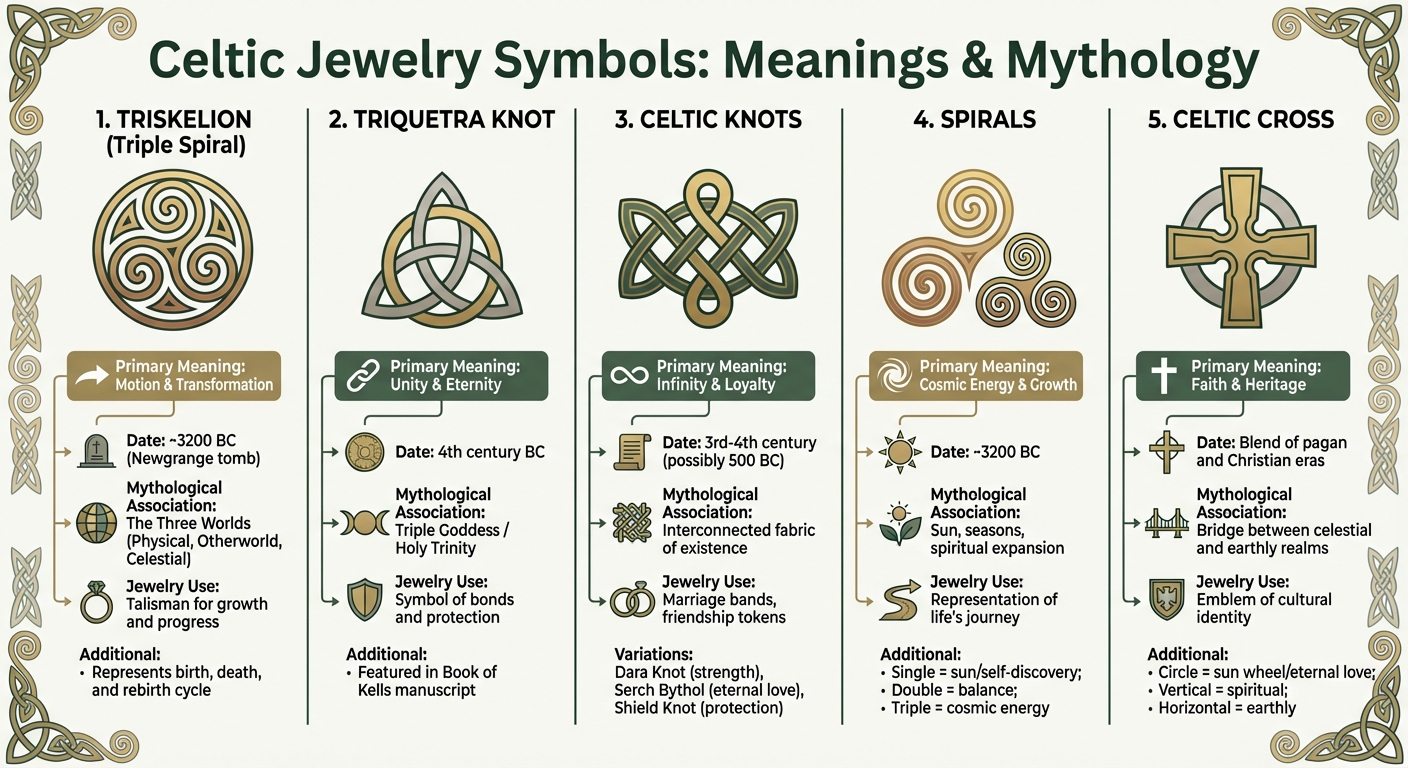
Celtic Jewelry Symbols: Meanings and Mythological Associations
Celtic symbols are more than just decorative elements; they carry deep mythological and spiritual significance. These motifs, often found in Celtic jewelry, reflect themes of love, transformation, strength, and the eternal pursuit of meaning. Each symbol tells a story, illustrating the enduring influence of Celtic culture and artistry.
Triskelion and Triple Spiral
The Triskelion, or triple spiral, is among the oldest known Celtic symbols, dating back to around 3200 BC. It was discovered on the Newgrange tomb in Ireland, predating even the Egyptian pyramids. This symbol features three spirals radiating from a central point, representing the three worlds in Celtic belief: the Physical, the Otherworld, and the Celestial. The swirling design signifies transformation, progress, and the cycle of life - birth, death, and rebirth. It also highlights the sacred importance of the number three in Celtic traditions, often tied to myths of the Triple Goddess.
Triquetra Knot
The Triquetra, with its three interlocking arcs, first appeared in the 4th century BC and has been a symbol of interconnectedness ever since. In pagan traditions, it represented the Triple Goddess, embodying the phases of a woman's life. Later, with the rise of Christianity, it came to symbolize the Holy Trinity. The Triquetra is prominently displayed in the Book of Kells, a ninth-century illuminated manuscript, showcasing its role as a bridge between pagan and Christian ideologies. Its design often conveys unity and the unbreakable bond between mind, body, and spirit.
Celtic Knots and Endless Loops
Celtic knots, with their intricate and unbroken patterns, are among the most recognizable symbols of Celtic artistry. These designs, often seen in manuscripts like the Book of Kells, represent eternity, loyalty, and the interconnectedness of life. Each knot is formed from a single continuous line, reflecting the belief in the unity of life, nature, and the divine. Specific knots carry unique meanings: the Dara Knot, inspired by the roots of an oak tree, symbolizes inner strength and resilience; the Serch Bythol, created from two interwoven Trinity Knots, represents eternal love; and the Shield Knot was traditionally worn for protection. These designs are especially popular in marriage jewelry, symbolizing a bond that endures forever.
Spirals in Celtic Jewelry
Spirals are another key motif in Celtic jewelry, symbolizing movement and growth. Dating back to around 3200 BC, these designs appear in single, double, and triple forms, each carrying its own meaning. A single spiral often represents the sun or an outward journey of self-discovery, while double spirals highlight the balance between opposing forces, like day and night. The triple spiral, closely tied to the Triskelion, symbolizes the flow of cosmic energy through the three realms of existence. Spirals serve as a reminder of life's constant evolution and the interconnected nature of transformation and growth.
Celtic Cross
The Celtic Cross combines pagan and Christian elements, creating a symbol rich in meaning. Its design - a cross within a circle - blends the Christian cross with the pagan sun wheel. The circle originally represented the sun's life-giving energy and the eternal cycle of the seasons. In Christian contexts, it came to signify God's eternal love. The vertical line of the cross points to the spiritual realm, while the horizontal line represents earthly life. The four arms of the cross are often associated with the elements or cardinal directions, adding layers of symbolism. Today, the Celtic Cross is a cherished emblem of faith and cultural pride.
| Symbol | Primary Meaning | Mythological Association | Jewelry Use |
|---|---|---|---|
| Triskelion | Motion & Transformation | The Three Worlds (Physical, Otherworld, Celestial) | Talisman for growth and progress |
| Triquetra | Unity & Eternity | Triple Goddess / Holy Trinity | Symbol of bonds and protection |
| Celtic Knots | Infinity & Loyalty | Interconnected fabric of existence | Marriage bands, friendship tokens |
| Spirals | Cosmic Energy & Growth | Sun, seasons, spiritual expansion | Representation of life's journey |
| Celtic Cross | Faith & Heritage | Bridge between celestial and earthly realms | Emblem of cultural identity |
Modern Interpretations and Applications
Celtic-Inspired Jewelry in Fashion
Drawing from its deep historical roots, modern jewelry breathes new life into ancient Celtic motifs, blending timeless symbolism with contemporary style. Symbols like the Tree of Life and the Trinity Knot are reimagined into sleek pendants, stackable rings, and even engagement bands designed for everyday wear. The ancient Torc, once a bold statement of power, now appears as lightweight necklaces or bracelets, maintaining its symbolic essence in a more practical form.
Advances in manufacturing have taken Celtic-inspired designs to the next level. Techniques like 3D CAD modeling combined with traditional casting allow for intricate details in materials such as rose gold, platinum, and gemstones like amethyst and emerald. Brands such as LaCkore Couture embrace these methods, offering handcrafted pieces in gold, silver, and natural stones. These designs honor Celtic heritage while aligning with modern fashion trends.
"Today's pieces feature gorgeous, meaningful symbols from different eras of Celtic history. They make the same statements the jewelry our ancestors wore did about the interconnectedness of all life and the importance of love, faith and family." - Stuart McGrath, Irish Master Craftsman
This seamless blend of tradition and innovation paves the way for jewelry that feels both personal and timeless.
Customization and Personal Meaning
Modern Celtic jewelry has evolved into a medium for personal storytelling, allowing wearers to imbue each piece with their own meaning. Specialized motifs like the Celtic Mothers Knot represent the bond between parent and child, while the Sisters Knot symbolizes enduring friendship. The Ogham alphabet - Ireland’s earliest writing system, with 20 letters each tied to sacred trees - offers another layer of personalization, enabling inscriptions of names or Gaelic words like Sonas (happiness).
Pricing reflects this range of customization. Sterling silver pendants are available for $30.00 to $85.00, while bespoke rose gold designs adorned with diamonds can cost up to $299.99. The Claddagh ring, a classic Celtic design, offers a unique form of expression: the direction of the heart signifies the wearer’s relationship status, with a heart facing outward on the right hand indicating singleness, and inward on the left hand symbolizing marriage.
This evolution of ancient symbols into personalized designs highlights how Celtic jewelry continues to celebrate identity and cultural heritage in meaningful ways.
Conclusion
Celtic jewelry bridges ancient mythology and contemporary self-expression. Dating back to the 8th century B.C., these symbols have long conveyed universal themes like the interconnectedness of life, the eternal cycle of growth, and the harmony of mind, body, and spirit. Without a written language, the ancient Celts relied on stone and metal carvings to pass down their traditions and worldview.
What began as practical Bronze Age items has transformed into meaningful adornments. For instance, ancient gold torcs - some weighing over 2.2 pounds - were once symbols of wealth and status. Today, the enduring appeal of Celtic knots, with their unbroken lines symbolizing eternal love, makes them a popular choice for engagement and wedding rings. These timeless designs continue to evolve, blending historical significance with modern reinterpretations.
"Celtic symbolism explains how they felt about the universe, life, death and the result of the changing seasons, so important to people who lived off the land." – Irish Jeweller
In today’s multicultural world, Celtic symbols have become powerful markers of ethnic identity, particularly for individuals of Irish, Scottish, and Welsh descent. Whether it’s a Trinity Knot pendant, a Claddagh ring symbolizing relationship status, or a Tree of Life design celebrating family roots, these pieces allow wearers to carry their heritage with pride. Ancient artisans, known as "men of art", perfected techniques that are now reflected in modern creations, often crafted with materials like rose gold and platinum.
From ancient stone carvings to personalized modern jewelry, Celtic symbols have retained their essence while adapting to new contexts. They resonate deeply with personal identity and shared human experiences, making them just as meaningful today as they were thousands of years ago. Artisans, including LaCkore Couture, continue to reimagine these motifs, offering high-quality, customizable pieces that celebrate both heritage and individuality.
FAQs
What does the number three symbolize in Celtic jewelry designs?
The number three carries profound symbolism in Celtic jewelry, often reflecting ideas of balance, unity, and the natural cycles of life. It’s closely tied to concepts like the Holy Trinity, the threefold goddess (Maiden, Mother, and Crone), and the three stages of life: birth, life, and death.
This meaningful number often appears in designs such as the triskelion and triquetra, which represent interconnectedness and spiritual harmony. These designs, steeped in history, continue to influence modern jewelry, blending their rich past with timeless elegance.
How do modern Celtic jewelry designs differ from ancient ones?
Ancient Celtic jewelry, originating in the Bronze Age, showcased bold and striking designs crafted from gold, silver, and bronze. Iconic pieces like thick torcs, crescent-shaped lunulae, and intricately engraved brooches stood out not just for their beauty but for their symbolic depth. Motifs such as knots, spirals, and animals often carried meanings tied to myths, protection, or significant life milestones. Every piece was hand-forged with remarkable attention to detail, reflecting the artistry of the era.
Modern Celtic jewelry continues to honor these traditional symbols - like trinity knots, Dara knots, and Celtic crosses - while giving them a contemporary twist. Today’s designs feature lighter metals, mixed materials, and natural stones, often personalized with elements like birthstones. The pieces are slimmer, more versatile, and benefit from advanced techniques such as laser-cutting and 3D modeling, merging timeless symbolism with modern style.
LaCkore Couture embraces this blend of tradition and innovation by offering handcrafted jewelry that reimagines classic Celtic designs in sleek, wearable forms. Using materials like gold, silver, and natural stones, their creations highlight quality craftsmanship and individuality, allowing wearers to connect with ancient symbolism in a way that feels both modern and personal.
What are the meanings behind common Celtic symbols in jewelry?
Celtic jewelry is known for its intricate designs and the deep meaning behind its symbols, many of which are rooted in mythology and tradition. Popular motifs include the Celtic cross, interwoven knots, spirals, and depictions of animals or mythical creatures like wolves and dragons. Historically, these designs were more than decorative - they conveyed spirituality, personal identity, and a connection to the natural world.
Take the Celtic spiral, for instance. As one of the oldest known symbols, it’s often tied to themes like the sun, life cycles, and spiritual growth. A clockwise spiral is thought to represent harmony and energy, while a counterclockwise spiral suggests introspection and enlightenment. Likewise, endless knots are powerful symbols of eternity, and the triskelion - a design featuring three spirals - reflects the continuous cycle of life, death, and rebirth. Each piece of Celtic-inspired jewelry carries these layered meanings, making it a tangible link to heritage and tradition.