Skip to content




Celestial Motifs in Ancient Rings and Charms
A star or crescent does not prove that a ring is ancient - or tell you what it meant. I start by recording the shape, wear, and nearby symbols, then check published examples and the object’s history.
I use five checks to guide that review:
- Stars and rays: Count points and distinguish sky shapes from flowers.
- Crescents and lunula pendants: Check hanging loops, orientation, and wear.
- Zodiac figures: Compare animals and people with the 12-sign sequence, inscriptions, and nearby imagery.
- Disks, bezels, and carved gems: Examine carving, lettering, materials, and possible seal use.
- Deities: Look for combinations of attributes, not just a face.
My rule is simple: <u>keep identification, meaning, and age separate</u>. I use “possibly” when details are unclear and seek an independent written assessment before calling a piece ancient. Ownership records, discovery records, and tests can help - but metal composition alone cannot prove age.
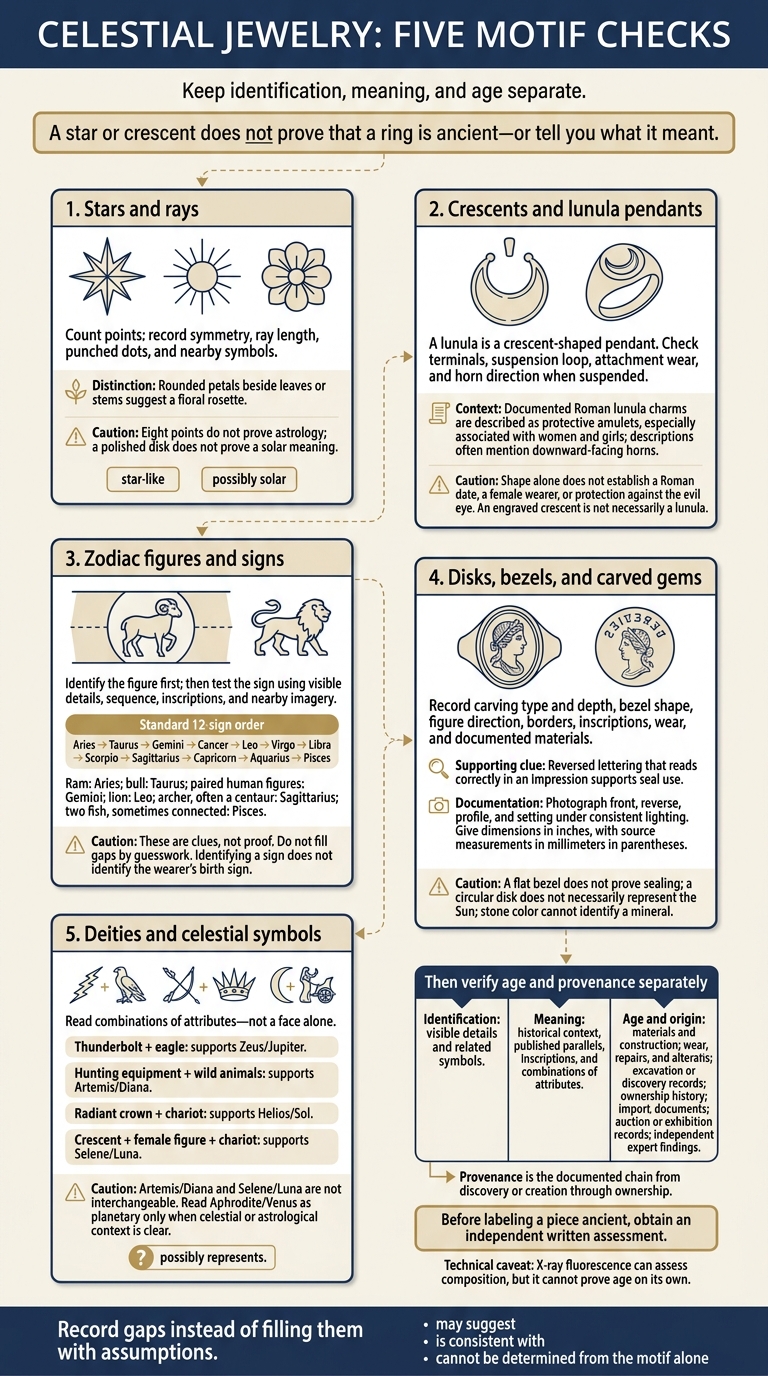
Celestial Jewelry: Five Motif Checks
Checklist: Stars and Crescents
Check 1: Stars, Rays, and Sun Shapes
Start with the clearest sky shapes: stars, rays, and sun disks.
Look for points, rays, and a central boss or disk. Rounded petals - especially beside leaves or stems - suggest a floral rosette instead. Record the symmetry, ray length, punched dots, and whether the motif appears alone or repeats.
A radiating disk beside a crescent, an inscription, or a radiate crown gives more support for a celestial reading than symmetry alone. Do not assume that eight points prove astrology, a polished disk represents the sun, or every dot marks a planet. Label uncertain forms star-like or possibly solar.
Once you’ve checked the basic star forms, see whether the shape is lunar instead.
Check 2: Crescents and Lunula Pendants
Look for a crescent with terminals and a suspension loop. A lunula is a crescent-shaped pendant. Suspension wear and orientation help identify it as jewelry. Record the terminal shape, attachment wear, and the direction the horns face when suspended. Check whether damage or a later mounting changed that position.
Documented Roman lunula charms are described as protective amulets, especially associated with women and girls. Descriptions often mention downward-facing horns. Base claims about protection on documentation, not shape alone. Link imagery on rings or charms to Selene/Luna or Artemis/Diana only when visible details support that identification, such as a lunar headdress, hunting equipment, animals, or a naming inscription.
Caution: A crescent alone does not establish a Roman date, a female wearer, or protection against the evil eye. An engraved crescent on a ring is not necessarily a lunula. Distinguish crescent forms from claws, teeth, and shell ornaments.
If the crescent appears with a sign or figure, move to the zodiac checklist next.
Check 3: Zodiac Figures and Signs
When celestial motifs take the form of people or animals, check whether they match the zodiac.
Identify the figure first, then test the sign using visible details and its place in a sequence. A ram or ram’s head may indicate Aries; a bull or bull’s head, Taurus; paired human figures, Gemini; a lion, Leo; an archer - often a centaur - Sagittarius; and two fish, sometimes connected, Pisces. Small engravings may show just a head or part of a body. These are clues, not proof: animals can also represent divine or mythological beings, or serve as decoration.
Check any circle or band for a zodiac sequence. The standard 12-sign order is Aries, Taurus, Gemini, Cancer, Leo, Virgo, Libra, Scorpio, Sagittarius, Capricorn, Aquarius, and Pisces. Look for neighboring figures, repeated compartments, radial divisions, concentric circles, or a continuous band. Don’t fill gaps by guesswork. A surviving sequence provides stronger support than a single animal.
Transcribe inscriptions exactly, noting their position and reading direction. Use nearby lunar or planetary imagery as evidence only when it forms a clear celestial setting.
| Classification | Supporting Evidence | Limitation |
|---|---|---|
| Confirmed zodiac sign | A recognizable figure supported by zodiac ordering, an identifying inscription, or a clear, structured celestial setting. | Identifies the imagery, not the wearer’s birth sign. |
| Possible celestial reference | A figure with stars, crescents, disks, rays, or planetary imagery, but no clear label or sequence. | May express broader religious or protective meaning. |
| Decorative animals | Standalone creatures without a clear celestial setting. | May still carry mythic or symbolic meaning. |
Use provenance, date, context, and parallels to interpret the design. If the design shifts from figures to settings or carved surfaces, check bezels and gemstones next.
Checklist: Engravings and Mythological Figures
A carved gem may combine a mythological figure, celestial details, and a protective or practical purpose, such as those found in silver charms. These meanings can overlap, but evidence for one does not prove the others.
Check 4: Disks, Bezels, and Carved Gemstones
When the motif moves from a sign to a carved gem or bezel, start with the carving and its setting.
Look for intaglio or cameo carving, a flat seal face, and a setting that keeps the engraving visible. Record the bezel shape, carving depth, figure direction, border patterns, inscriptions, wear, and documented materials. Give dimensions in inches, with the source measurements in millimeters in parentheses. Photograph the front, reverse, profile, and setting under consistent lighting.
Consider display and seal use together. Was the engraving meant to be viewed, pressed into wax or clay, or both? Check the inscription’s orientation: reversed lettering that reads correctly in an impression supports seal use.
A flat bezel alone does not prove sealing, and a circular disk does not necessarily represent the Sun. Stone color cannot identify a mineral, either. Age, origin, and gemstone type require independent documentation - not just a judgment based on appearance.
Check 5: Deities and Celestial Symbols
Once you identify the carving, use the figure’s attributes - not its face alone - to assess which deity it may depict.
Look for lightning, eagles, radiant crowns, crescents, hunting equipment, chariots, animals, and identifying text. Record where the attributes appear, which objects the figure holds, the ray count, and any horses or reins.
Read the attributes in combination. A thunderbolt and eagle together support Zeus/Jupiter; hunting equipment and wild animals support Artemis/Diana. A radiant crown paired with a chariot supports Helios/Sol, while a crescent paired with a female figure and chariot supports Selene/Luna. Keep hunting and lunar readings separate: Artemis/Diana and Selene/Luna are not interchangeable.
Do not identify a deity from a face alone, label an incomplete held object a thunderbolt, or treat every radiant head as the sun god. Read Aphrodite/Venus as planetary only when the celestial or astrological context is clear. Doves, love imagery, and romantic inscriptions may point to affection or dedication rather than planetary Venus.
When attributes are incomplete, use:
“possibly represents”
rather than naming the deity with certainty.
Conclusion: Review Meanings and Check Origins
Review the five checks: stars and rays, crescents and lunula pendants, zodiac figures, disks or engraved gemstones, and deities or mythological figures.
Record the visible details, read related symbols together, and use “may suggest,” “is consistent with,” or “cannot be determined from the motif alone” when evidence is limited.
Compare Support for Symbolic Meanings
| Evidence | What It Supports | What Remains Uncertain |
|---|---|---|
| Motif alone | Visual identification of a possible celestial element | Exact meaning, date, region, maker, and whether the jewelry is ancient, modern, or a revival piece |
| Motif with attributes | A stronger comparison with known artistic types based on imagery and associated details | Whether the maker intended the usual meaning and whether the object dates to the proposed period |
| Motif with an inscription | Possible identification of a person, deity, owner, workshop, language, or dedication, depending on the reading | Whether the inscription is genuine, its translation and date, and how the text relates to the image |
| Motif with documented archaeological provenance | Discovery context, approximate dating, and association with a particular society | Whether each symbolic interpretation is correct, whether the object is complete or altered, and whether the documentation is reliable |
More context supports an interpretation, but it doesn’t prove every claimed meaning. Provenance is the documented chain from discovery or creation through ownership. It is separate from interpreting what you see. Visual clues suggest meaning; documentation helps establish age and origin.
After interpreting the imagery, check the object’s age and documented history separately.
Final Checklist: Verify Age and Provenance
Check materials and construction, wear, repairs and alterations, motif placement, inscriptions and maker’s marks, excavation or discovery records, ownership history, import or export documents, auction or exhibition records, and independent expert findings.
Keep excavation history, ownership records, and specialist conclusions separate from details you can observe directly on the object. Record gaps instead of filling them with assumptions.
Before labeling a piece ancient, obtain an independent written assessment to distinguish it from a reproduction or later revival. Use a qualified specialist in Greek and Roman jewelry, classical art, archaeology, or antiquities authentication. Request suitable analysis when needed: X-ray fluorescence can assess composition, but it cannot prove age on its own. Support identification with visual evidence, meaning with historical context, and age and origin with documentary and technical evidence.
FAQs
What should an expert’s written assessment include?
An expert’s written assessment of a ring or charm should cover construction, quality, and craftsmanship. It should verify that gemstones are securely set and their carat weights are accurate. This matters especially for smaller stones in cluster settings, where incorrect weights could inflate the price.
Gently shake the piece near your ear. If you hear rattling, it may mean a stone is loose. The assessment should also confirm that the piece is durable and well-made.
Can an ancient gem have a modern setting?
Yes, an ancient gem can be placed in a modern setting. Modern jewelry design pairs ancient motifs and materials with current styles and techniques, including 24K gold dipping and durable plating. Wearers can honor a piece’s origins while giving it an updated look that fits their modern wardrobe.
How can I research a motif without provenance?
Start with the piece’s main motif, then check its materials, craftsmanship, and any inscriptions on the front, back, or clasp. These details can help narrow down its purpose.
Compare the design with historical artwork, statues, and sculptures to learn how ancient jewelry was worn and what its symbols meant. Use those clues alongside the piece’s physical details to interpret the motif’s intended message.