Skip to content




Cameos and Intaglios: Victorian Jewelry Trends
Cameos and intaglios were iconic jewelry styles of the Victorian era, celebrated for their artistry and symbolism. Cameos have raised designs, often carved from shells or hardstones, while intaglios feature recessed engravings used historically as seals. Queen Victoria’s passion for these pieces popularized them among the middle class, making them accessible through affordable materials like shell and lava stone. Victorian designs often depicted mythological figures, romantic themes, and sentimental symbols, reflecting the era's values.
Collectors today look for genuine materials, hand-carved details, and historical significance. Techniques like the light test and inspecting for tool marks help differentiate authentic pieces from modern reproductions. Victorian-inspired jewelry continues to influence modern designs, blending historical charm with personal expression.
What Are Cameos and Intaglios?
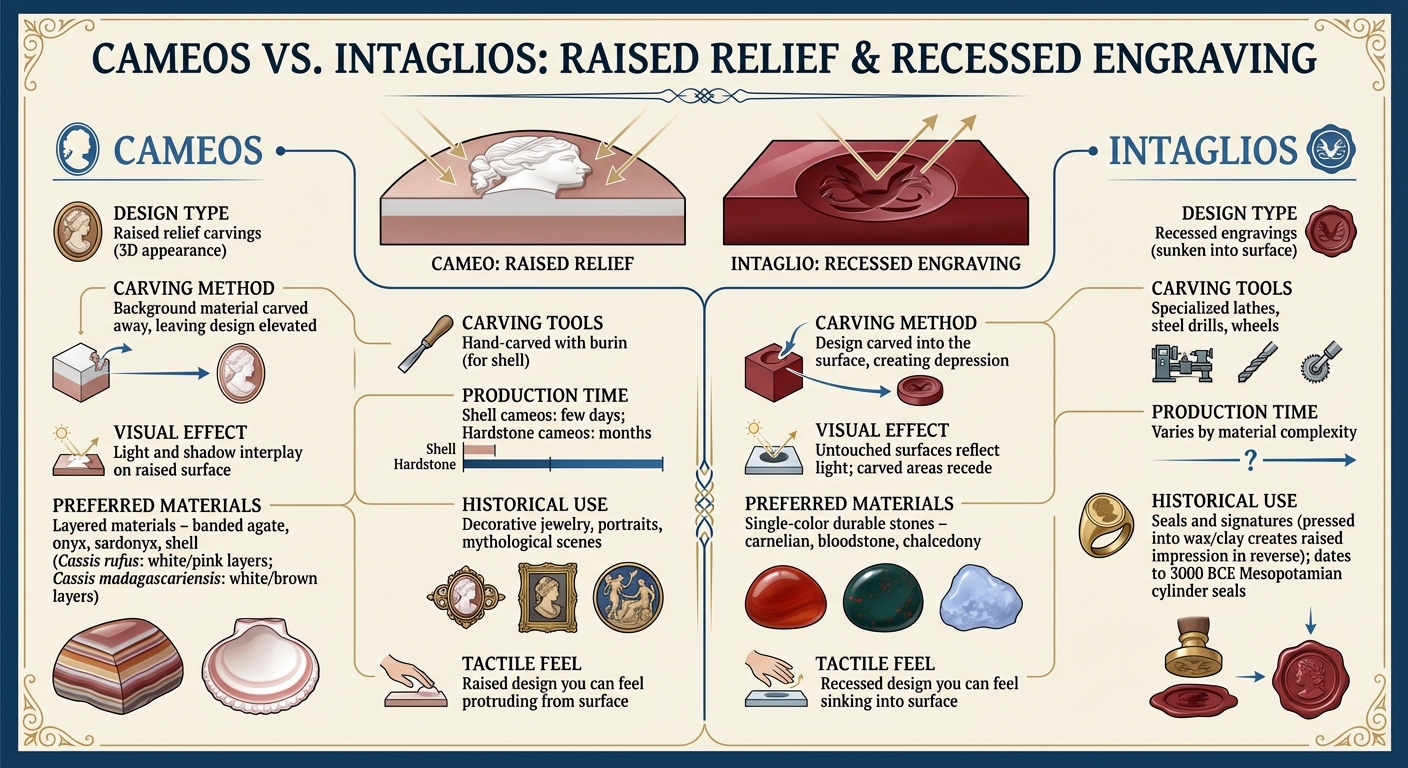
Cameos vs Intaglios: Key Differences and Characteristics
Cameos and intaglios are two distinct types of carvings, each with its own unique characteristics, much like the bespoke jewelry collections found today. Cameos feature raised designs that stand out from the background, while intaglios are the opposite, with recessed engravings that sink into the surface. These differences are not just visual - they’re tactile too, offering a clear distinction in how each piece feels to the touch.
Cameos: Raised Relief Carvings
Cameos are created by carving away the background material, leaving the design raised and giving it a three-dimensional appearance. This effect is enhanced by the interplay of light and shadow. The technique works especially well with layered materials like banded agate, onyx, sardonyx, or shell. These materials naturally provide contrasting colors, such as a lighter design against a darker background, making the details pop.
For instance, the Cassis rufus shell had white and pink layers, while the Cassis madagascariensis (also known as the Emperor helmet shell) offered white and brown layers, providing a striking palette for carvers. Hardstone cameos required intricate work with specialized lathes, steel drills, and wheels - a process that could take months to complete. On the other hand, shell cameos were carved by hand using a burin and could be finished in just a few days. This faster process made shell cameos more affordable, allowing them to become popular among the Victorian middle class.
Intaglios: Engraved Designs
Intaglios are the reverse of cameos, featuring designs carved into the surface to create a recessed image. The carved areas sink into the material, while the untouched surfaces reflect light. Historically, intaglios were more than decorative - they served practical purposes as seals and signatures. The earliest examples, Mesopotamian cylinder seals, date back to around 3000 BCE. When pressed into hot wax or clay, an intaglio would leave a raised impression of its design in reverse, revealing its full detail.
Carvers of intaglios preferred using durable, single-color stones like carnelian, bloodstone, and chalcedony. These materials were tough enough to handle the repeated pressure of stamping without breaking, making them ideal for signet rings used to seal letters and legal documents.
How Cameos and Intaglios Became Popular in Victorian Fashion
Queen Victoria's Impact on Jewelry Styles
Queen Victoria didn’t just wear jewelry - she shaped the way an entire generation thought about it. Her passion for sentimental designs brought new meaning to accessories, influencing middle-class tastes in ways that still echo today. For example, she adored snake rings, which symbolized eternal love, and acrostic jewelry, where the first letter of each gemstone spelled out words like "DEAREST" (Diamond, Emerald, Amethyst, Ruby, Emerald, Sapphire, Topaz).
"The queen, a deep lover of the goldsmith's art, draws herself some Intaglio cameo pieces, dictating the English fashion of the jewel until the end of the 19th century." - Marco Jovon
Victoria’s embrace of shell cameos as everyday accessories made them more accessible to the growing middle class. These pieces, crafted quickly by hand, were far more affordable than earlier, more elaborate versions. The affordability was further boosted by the 1854 gold marking law, which introduced 15-carat gold settings - durable yet cost-effective for a wider audience.
When Prince Albert passed away in 1861, the Queen’s prolonged mourning period sparked a new trend: mourning cameos. These pieces were often carved from dark materials like Whitby jet, vulcanite, and gutta-percha. Victoria even commissioned works from renowned carvers, including the Saulini family and James Ronca, for the Royal Order of Victoria & Albert. While mourning cameos surged in popularity, intaglios - used mainly for sealing - began to fade out after 1840, as modern sealing methods took over.
This blend of practicality and sentimentality defined the era’s jewelry trends, making them both meaningful and accessible.
Symbolism and Romantic Themes
Under Queen Victoria's influence, cameos became more than just decorative - they told stories. The Victorian era’s love for romantic idealism and sentimentality made these pieces a perfect medium for symbolic expression. One of the most popular designs was the "anonymous woman", a female profile whose hairstyle and facial features mirrored the fashion trends of the time.
Beyond anonymous figures, Victorian cameos often featured mythological characters like Diana and Psyche or biblical scenes such as "Rebecca at the Well." These designs weren’t just beautiful - they were rich with meaning. For tourists on the Grand Tour in Italy, cameos carved from shell or lava became prized souvenirs. These wearable works of art depicted classical Roman and Greek scenes, serving as intellectual keepsakes that reflected the traveler’s cultural sophistication.
Symbolism was everywhere in Victorian jewelry. Anchors represented hope, hearts conveyed affection, and ivy symbolized constancy. Toward the late 19th century, the cameo habillé style emerged, adding a playful twist: the carved figures themselves "wore" tiny pieces of jewelry, like miniature diamond necklaces. This combination of intricate craftsmanship and layered meaning perfectly encapsulated the Victorian era’s fascination with romance, memory, and intellectual depth.
Materials and Craftsmanship in Victorian Cameos and Intaglios
Materials Used in Cameos and Intaglios
Victorian cameos and intaglios were defined by the materials artisans chose, each lending its own character to the finished piece. For high-end cameos, hardstones like jade, agate, onyx, and sardonyx were the gold standard. These stones featured natural color layers that created striking depth, with lighter figures appearing to rise from darker backgrounds. While their durability was a huge advantage, these stones were notoriously difficult to carve and came with a hefty price tag.
The market saw a major shift around 1810 with the introduction of shell as a carving material. Tropical helmet shells, such as Cassus rufus (white and pink) and Cassus madagascariensis (white and brown), were softer and much easier to work with than hardstone. This made them a more affordable option, opening the world of cameos to the middle class. The deep white layer of these shells allowed for intricate, high-relief designs that were both elegant and detailed.
For travelers visiting Italy, lava stone from Mt. Vesuvius became a popular choice. Its matte finish, reminiscent of "biscuit porcelain", gave it a unique texture, and it allowed for deep, sculptural reliefs. However, it was more fragile compared to shell or hardstone [6,15]. Meanwhile, glass pastes - molded imitations of stone carvings - offered an even more affordable option. Artisans like John Tassie pioneered this technique, making it possible to replicate the look of expensive materials without the cost.
These material choices not only shaped the aesthetic appeal of cameos and intaglios but also reflected the Victorian era's drive to blend luxury with accessibility. Each material brought its own challenges and opportunities, setting the stage for the intricate craftsmanship that followed.
Carving Techniques and Skills Required
The artistry behind Victorian cameos and intaglios was nothing short of extraordinary. Hardstone carving required immense skill and patience. Using specialized lathes with steel drills and wheels, carvers often spent months perfecting a single piece. Every cut had to be precise - one wrong move could destroy weeks of painstaking work.
"Hardstone was favored for its durability but was considerably more difficult to carve." - Market Square Jewelers
In contrast, shell carving was faster and more forgiving. Artisans used handheld burins to shape the softer material, often completing a piece in just a few days. Victorian carvers frequently worked from marble busts, plaster casts, or even photographs to create lifelike portraits. By the mid-18th century, some artisans began signing their work, a practice intended to protect their creations from being misrepresented as antique originals.
This blend of technical mastery and artistic vision ensured that each piece was both a work of art and a testament to the skill of its creator. Whether working with the resilience of hardstone or the pliability of shell, Victorian craftsmen elevated cameo and intaglio carving to an art form that continues to captivate today.
Collecting Victorian Cameos and Intaglios Today
How to Identify Genuine Victorian Pieces
Identifying an authentic Victorian cameo or intaglio takes a keen eye and a few practical techniques. Genuine pieces are typically crafted from materials like shell (conch or helmet), hardstone (agate, sardonyx, onyx), coral, lava, or glass. One quick test involves touch - authentic shell, stone, and glass tend to stay cool longer than plastic imitations.
The "light test" is especially useful for shell cameos. Hold the piece against a strong light source. Real shell is thin and translucent, often revealing a soft glow or even the silhouette of the carving when viewed from the back. In contrast, plastic reproductions and hardstone cameos remain opaque.
Using a 10× jeweler's loupe, inspect the carving for irregularities. Hand-carved pieces often show uneven tool marks and varying depths, particularly behind the raised design. By 1991, it was estimated that up to 80% of cameos on the market were machine-cut using ultrasound in Germany and Japan. Machine-made pieces typically display uniform, parallel striations that resemble "freshly fallen snow" under magnification.
"The finer the features and sharper and deeper the detail, the better the cameo." – Dr. Anthony Cavo, Certified Appraiser
Pay close attention to the design. Victorian-era profiles often feature a straight "Roman" nose with a prominent bridge, while 20th-century reproductions tend to have more upturned or "pug" noses. The clasp mechanism can also be a clue - 19th-century brooches often use a simple "C-clasp", where the pin extends past the frame's edge, as safety catches became common only in the early 20th century.
Look for distinctive features, such as "habillé" cameos, where the subject is adorned with miniature jewelry, like a tiny diamond necklace. These became popular in the 1840s and remain highly collectible. Also, examine the back of shell cameos - authentic ones usually follow the shell's natural curve, while plastic versions are often flat.
Once you've verified authenticity, you're ready to start building your collection.
Building Your Collection
Building a collection of Victorian cameos or intaglios takes time and a discerning eye. By applying the identification techniques above, you can confidently evaluate pieces at estate sales, flea markets, antique jewelry shops, and reputable auction houses.
Begin with more affordable shell cameos to develop your expertise, then progress to rarer hardstone pieces as your confidence grows. Hardstone cameos typically command the highest prices, followed by coral and lava pieces, while shell cameos are a great starting point for new collectors. Scenic cameos, which depict landscapes or intricate mythological scenes, are especially rare and often more valuable than simpler portrait designs.
Always assess a piece's condition before purchasing. Chips, cracks, or "crazing" (fine stress lines in shell) can significantly lower its value. Use the light test to spot any stress lines that might compromise the integrity of shell pieces. For cleaning, stick to warm, soapy water and a soft cloth. Avoid ultrasonic cleaners, as they can damage delicate materials like shell and coral.
Finally, keep an eye out for signatures from prominent Victorian-era carvers like the Saulini family (T. Saulini or L. Saulini), James Ronca, and Adolphe David. These artisans began signing their work in the mid-18th century to distinguish their creations from ancient originals. Signed pieces often carry extra historical significance, adding depth to your collection. Each authentic piece tells its own story, connecting you to the artistry and elegance of the Victorian era.
Victorian-Inspired Jewelry: LaCkore Couture's Handcrafted Collections

Victorian Motifs in Contemporary Jewelry Design
Victorian jewelry, known for its three distinct periods - Romantic, Grand, and Aesthetic - continues to influence modern design with its nature-inspired motifs and bold revival styles. LaCkore Couture embraces this legacy, weaving intricate metalwork, symbolic imagery, and romantic themes into their contemporary, U.S.-made pieces.
The brand pays homage to the Victorian era's intellectual elegance, reflected in the popularity of cameos. Back then, these pieces often depicted subjects from Greek and Roman mythology, signaling a deep appreciation for cultural refinement. Today, techniques like intaglio carving have seen a resurgence, especially with the growing appeal of personalized signet rings. Pairing Victorian-inspired designs with minimalist bands creates a striking blend of historical charm and modern simplicity. This approach honors timeless traditions while offering a fresh take on elegance for today’s jewelry enthusiasts.
Handcrafted Quality and Customization Options
LaCkore Couture’s dedication to craftsmanship sets their jewelry apart from mass-produced options. Each piece is crafted by hand, showcasing details like gold filled, solid gold, sterling silver, and natural stones - materials chosen for their durability and beauty. Subtle imperfections, such as variations in wire thickness or hand-finished prongs, highlight the artistry behind these heirloom-quality creations.
The brand also offers customization through its Charm Bar, where customers can design gold and silver charm necklaces or bracelets to reflect their personal style. Popular motifs include zodiac signs, heart designs, and demi-fine collections. Customers frequently praise the meticulous craftsmanship and high-quality materials. Every piece combines the romantic essence of Victorian jewelry with the durability and individuality that modern jewelry lovers value.
Conclusion
From their ancient beginnings to the Victorian era's reimagining, cameos and intaglios have long reflected the shifting narratives of human history. For over 5,000 years, these intricate pieces have served as symbols of historical milestones and as protective talismans against misfortune. From the cylinder seals of ancient Mesopotamia to the Victorian period's celebrated "golden age of cameos", they have consistently transcended time, offering a unique way to express individuality. The Victorians, in particular, elevated these pieces into "smart jewelry", featuring intellectual and classical themes that resonated with their era's values.
Today, these historic art forms continue to enchant collectors and enthusiasts alike. As Jonathan’s Fine Jewelers describes:
"At first glance, a cameo might look like a delicate portrait carved into shell or stone, but once you hold one in your hand, you realize it's more than jewelry - it's a piece of history".
The combination of their historical allure and adaptability to modern design ensures their relevance in contemporary jewelry collections.
Blending the elegance of the past with modern aesthetics, designers like LaCkore Couture draw heavily from Victorian sophistication. Their handcrafted creations incorporate Victorian-inspired motifs while embracing contemporary design elements. Whether you’re captivated by symbolic imagery, intricate metalwork, or the opportunity for personalization, LaCkore Couture’s dedication to craftsmanship ensures that you can own jewelry that not only honors history but also speaks to your unique style.
The timeless charm of cameos and intaglios lies in their ability to tell stories that span generations. By embracing Victorian-inspired designs, you become part of a tradition that has been shaped, one carved detail at a time, over the course of millennia.
FAQs
Are Victorian cameos still wearable every day?
Victorian cameos exude a sense of timeless elegance, making them ideal for special occasions or as standout accessories. Their detailed craftsmanship and historical charm, however, often place them outside the realm of casual, everyday wear.
What affects the price of a Victorian cameo or intaglio?
The value of a Victorian cameo or intaglio hinges on several factors, including age, materials used, level of craftsmanship, and provenance. Older pieces tend to fetch higher prices, especially when crafted from premium materials and showcasing detailed, skillful work. Additionally, items with a documented history or ties to prominent individuals can significantly boost their market worth.
How should I store and care for antique cameos?
To keep antique cameos in great condition, store them in a dry, cool spot, away from direct sunlight to prevent fading or damage. Use a soft cloth or padded box to keep them separate from other jewelry, which helps avoid scratches.
When handling, be gentle and steer clear of harsh chemicals, perfumes, or extreme temperatures that could harm the material. For cleaning, use a soft, damp cloth and avoid abrasive cleaners or ultrasonic machines. Regularly inspect your cameos for any signs of wear or damage to ensure they stay in top shape.