Skip to content




Black Stones: Meanings, Power, and Use
If you want a black stone that lasts in everyday jewelry, start with black diamond, black sapphire, or black spinel. If you want softer mood, lower cost, or a certain look, options like onyx, obsidian, jet, hematite, tourmaline, and black pearls can fit better - but they need more care.
Here’s the short version:
- Best for daily rings: black diamond (Mohs 10), black sapphire (9), black spinel (8)
- Best for pendants and earrings: black onyx (6.5–7), black tourmaline (7–7.5), obsidian (5–5.5), jet (2.5–4), black pearl (2.5–3)
- Main meanings people attach to black stones: protection, strength, confidence, grounding, mystery, remembrance
- What changes the look most: polish, matte finish, faceting, carved texture, and metal color
- What to ask before buying: stone name, whether the color is natural or treated, finish, and care needs
One fact matters right away: Mohs hardness measures scratch resistance, not how well a stone handles chips or hard hits. So a ring worn every day needs more than a nice look - it needs the right stone and the right setting.
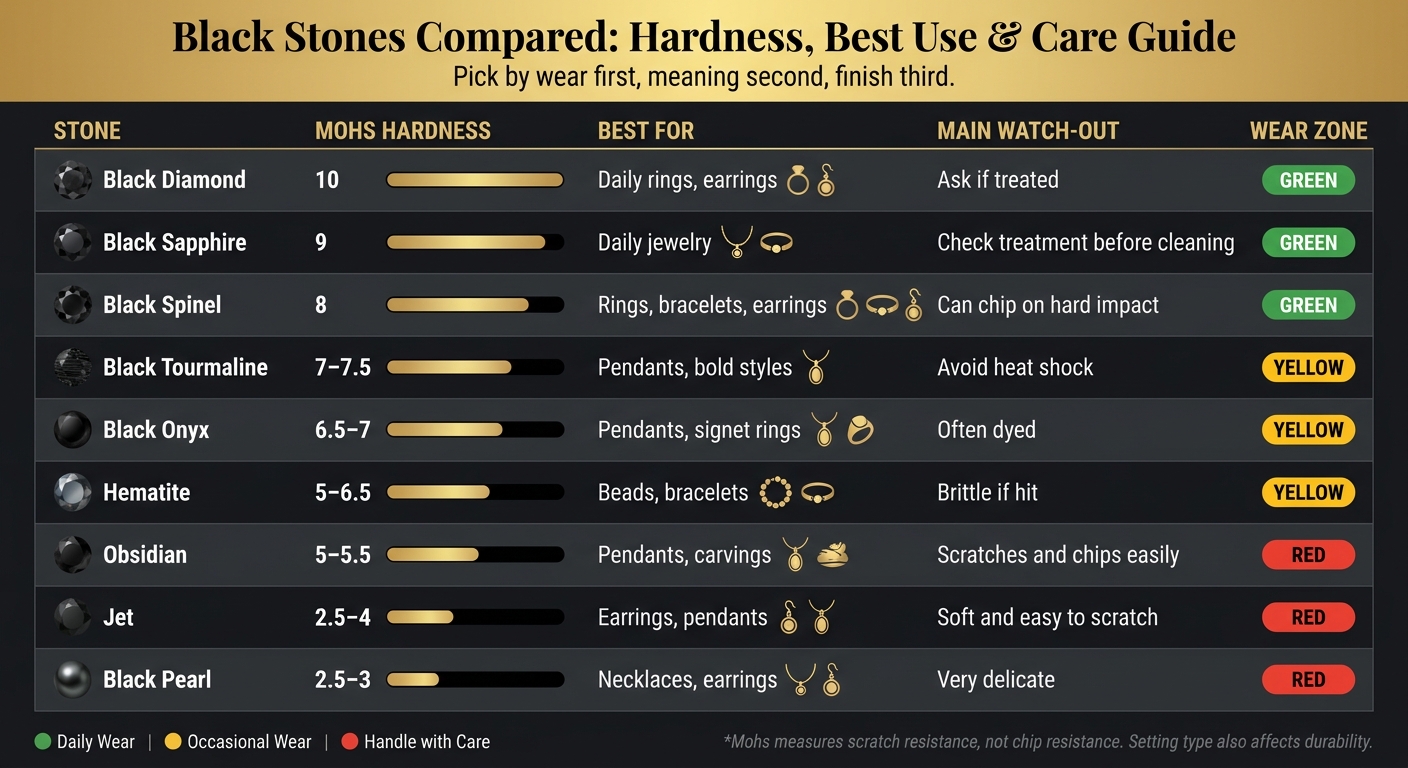
Black Stones Compared: Hardness, Best Use & Care Guide
Quick comparison
| Stone | Mohs hardness | Best use | Main watchout |
|---|---|---|---|
| Black diamond | 10 | Daily rings, earrings | Ask if treated |
| Black sapphire | 9 | Daily jewelry | Check treatment before cleaning |
| Black spinel | 8 | Rings, bracelets, earrings | Can still chip on hard impact |
| Black tourmaline | 7–7.5 | Pendants, bold styles | Avoid heat shock |
| Black onyx | 6.5–7 | Pendants, signet rings | Often dyed |
| Hematite | 5–6.5 | Beads, bracelets | Brittle if hit |
| Obsidian | 5–5.5 | Pendants, carvings | Scratches and chips more easily |
| Jet | 2.5–4 | Earrings, pendants | Soft and easy to scratch |
| Black pearl | 2.5–3 | Necklaces, earrings | Very delicate |
I’d sum it up this way: pick black stones by wear first, meaning second, and finish third. That keeps the choice simple and helps you get a piece you’ll keep wearing instead of leaving in a box.
Black Stone Meanings and Symbolism
Black stone meaning depends on context. It can come from history, style, or belief. In practice, those three layers often overlap, and they shape how people choose and wear black stones.
Cultural Symbolism, Style Meaning, and Spiritual Belief
Historical symbolism comes from how a stone was used in a given time and place. Black jet is a good example. It became tied to mourning during the Victorian era. That kind of meaning sticks because people attach emotion and ritual to an object over time. Style meaning and spiritual meaning work in a different way, which is why black stone jewelry can carry more than one message at once.
Modern style associations are mostly visual. A polished black stone can suggest sophistication and authority. A matte or rough-cut stone tends to feel earthy and understated. Those are style impressions shaped by fashion and social context, not fixed psychological laws.
Spiritual interpretation sits in its own category. In modern metaphysical practice, black tourmaline is often described as protective, obsidian as tied to introspection and transformation, and black onyx as grounding and strengthening. These are beliefs, not proven effects. The meaning is symbolic, not scientific.
So when a stone is said to offer "protection" or "grounding energy", it makes more sense to read that as part of a spiritual practice, not as a literal product promise. For many people, those meanings still matter. They can help match a stone to the piece, the occasion, and the person wearing it.
Why Black Stones Feel Personal to the Wearer
Black jewelry is quieter than bright gemstones. That gives the wearer more space to decide what it means. Put simply, black jewelry often feels personal because the meaning doesn't shout at you. It comes from the wearer, the moment, and the story attached to it.
"Instead, focus on the value, meaning, and beauty you find in the stone." - LaCkore Couture
With those meanings in mind, the next section turns to the black stones most often used in jewelry.
Common Black Stones Used in Jewelry
Once you know what each black stone stands for, the next step is simpler: figure out how you’ll wear it. That part matters more than many buyers expect.
Not every black stone is built the same way. Some are minerals. Some are volcanic glass. Some come from fossilized wood. Some are organic. And that changes both the look and the wearability. A stone that works well in a pendant may not be the best pick for a ring you wear every day.
Durable Black Stones for Rings, Earrings, and Daily Wear
If you're shopping for rings, bracelets, or other pieces that see a lot of use, black diamond, black sapphire, and black spinel are the standouts. Black diamond ranks 10 on the Mohs scale, black sapphire ranks 9, and black spinel ranks 8. All three sit well above the common 7 Mohs baseline often used for frequent wear.
Black spinel is an especially good option if you like a faceted, glossy look close to black diamond but want a stone that still handles regular wear well.
Black onyx is another popular option, especially for polished cabochons and signet-style designs. It comes in at about 6.5–7 on the Mohs scale, so it does well in earrings, pendants, and signet rings. For rings, though, it’s smarter in a bezel or low-profile setting because that can lower the chance of chipping.
There’s one more thing to know about onyx before buying. A large share of commercial black onyx is dyed chalcedony, not material that formed black on its own. So it’s worth asking whether the color is natural or treated.
Textured and Earthy Black Materials
Black tourmaline, known in this color variety as schorl, often has long, parallel surface lines. That gives it a rougher, more textured feel than highly polished stones. At 7–7.5 Mohs, it works well in pendants, beaded pieces, and bold jewelry styles.
Obsidian is volcanic glass, and that’s a big part of its appeal. It can show a dark, mirror-like surface that looks striking in carved or sculptural jewelry. But it’s softer than many people expect. At only 5–5.5 Mohs, it scratches and chips more easily, so it tends to work better in earrings and pendants than in rings.
Hematite has a metallic, steel-black shine that feels different from the glossy surface of obsidian and the flatter look of onyx. It’s common in beads and pared-back jewelry, but it can be brittle if hit hard.
Jet sits in a category of its own. It’s organic, formed from fossilized wood, and it often feels light in the hand and warm to the touch. Its hardness is only 2.5–4 Mohs, so it scratches easily. Because of that, it’s best for lower-contact pieces like earrings and pendants.
Organic Black Materials with a Softer Look
Black pearls, including dark Tahitian cultured pearls, are very different from black mineral stones. They’re made by mollusks and coated in nacre, which gives them a soft, layered glow. Their overtones can shift between green, gray, blue, and purple, which is part of what makes them so appealing.
They’re also delicate. GIA rates pearls at just 2.5–3 on the Mohs scale. That means care matters. Put them on after cosmetics, wipe them after wearing them, and keep them away from steam, ultrasonic cleaning, and harsh chemicals.
That softer nature is also why black pearls are such a natural fit for necklaces, earrings, and gift jewelry. Their appeal comes less from solid, even opacity and more from elegance and shifting color.
The table below compares hardness, common uses, and care at a glance.
| Material | Approx. Mohs Hardness | Common Settings | Main Care Concern |
|---|---|---|---|
| Black diamond | 10 | Engagement rings, pavé, statement rings, earrings | Confirm treatment before steam/ultrasonic cleaning |
| Black sapphire | 9 | Rings, earrings, everyday jewelry | Check for treatments before cleaning |
| Black spinel | 8 | Faceted rings, earrings, bracelets | Gentle cleaning; avoid severe blows |
| Black tourmaline | 7–7.5 | Pendants, statement rings, beaded jewelry | Avoid steam and sudden temperature changes |
| Black onyx | 6.5–7 | Cabochon rings, pendants, signet styles | Avoid abrasives; dyed material needs conservative care |
| Hematite | 5–6.5 | Beads, bracelets, minimalist rings | Protect from impact and prolonged moisture |
| Obsidian | 5–5.5 | Pendants, cabochons, earrings | Prone to scratching and chipping |
| Jet | 2.5–4 | Pendants, beads, earrings | Avoid scratches, heat, and chemicals |
| Black pearl | 2.5–3 | Strands, earrings, pendants | No steam, ultrasonic, or harsh chemicals |
One last point: Mohs measures scratch resistance, not resistance to chipping. Fractures, inclusions, and treatments can still change how a stone holds up in daily wear.
How Black Stones Get Their Color and Why Buyers Like the Look
After hardness and day-to-day wear, the next question is simple: what makes a stone black in the first place?
The answer isn't simple at all. Black isn't one material or one source. A stone can look black because of its mineral makeup, packed inclusions, metallic structure, volcanic glass, or even organic matter. So two stones may look almost identical at a glance, yet get their color in completely different ways. And when you're buying, that difference matters.
Natural Color, Treatments, and Product Transparency
Some stones are black because of what sits inside the material itself. Black diamonds are a good example. Their color can come from dense inclusions of graphite and other dark minerals that absorb light throughout the crystal. GIA identifies black diamonds in grading documents as Fancy Black, and the report notes whether that color is natural or treated.
That detail matters. Treated black diamonds are often made through high-temperature, low-pressure heating, which darkens material inside fractures.
Black onyx offers a useful comparison. Most black onyx sold on the market starts as gray or pale chalcedony and is then darkened with dye. That means the color can be more prone to damage from chemicals, heat, and abrasion than a material that is naturally dark.
A good product listing should spell out the basics:
- the stone name
- whether the color is natural or treated
- the surface finish
- any special care needs
If a listing only says "black stone," that's too vague. A plain, honest format works best: Black onyx, dyed, high polish, avoid harsh chemicals. For higher-priced pieces, especially black diamonds, it's smart to ask for an independent gem lab report from GIA or a similar lab.
Polish, Matte Finish, Faceting, and Carved Texture
Finish can completely change how a black stone feels in jewelry.
A high polish gives the surface a sleek, mirror-like look. It feels sharp, dressy, and bold next to polished metal. A matte or raw surface does the opposite. Instead of bouncing light back, it diffuses it, which gives the stone a quieter and more relaxed look. That's often a great fit for casual pieces or layered styling.
Faceting changes the look again. Those angled cuts create flashes of light and small highlights, so even an opaque black stone can feel more lively. Beads and carved forms push the mood in other directions. Rounded beads tend to feel easier and more everyday. Carved shapes can feel more personal, especially when the carving has a symbol, motif, or distinct form.
Why Black Stones Work in Modern Handcrafted Jewelry
These visual qualities also explain why black stones fit so well into modern handcrafted jewelry.
Black works like a neutral. It creates strong contrast with yellow gold, looks cooler with sterling silver or white gold, and blends into a more tonal style with blackened or gunmetal finishes. In handcrafted pieces, black stones often act as grounding accents in necklaces, earrings, bracelets, rings, and charms. They help anchor the design while letting the rest of the piece shift in style, shape, or color.
Choosing Black Stone Jewelry for Daily Wear and Gifts
Best Black Stone Jewelry Choices by Jewelry Type
After color, finish, and material, the next thing to think about is simple: how will this stone hold up in day-to-day life?
Black stones don't all wear the same way. Some are harder. Some resist chipping better. Some look great at first but need more care over time. That's why the best pick depends less on price and more on where the jewelry sits, how often it gets bumped, and how strong the setting is. Hardness matters, but toughness and stability often matter more.
Rings and bracelets deal with the most contact. They hit desks, brush against bags, and take a beating without you even noticing. For those pieces, it's smart to choose stones rated 7 or higher on the Mohs scale. Black diamond (10), black sapphire (9), and black spinel (8) are some of the strongest picks for everyday wear. A bezel setting gives added protection, and a lower-profile design is less likely to snag.
Necklaces and earrings have it easier. Since they usually face less impact, they can work well with softer stones like black onyx, which is usually around Mohs 6.5–7. With earrings, focus on light weight and secure backs. With necklaces, pay close attention to the bail and chain. A pretty stone doesn't help much if the hardware is flimsy.
Use the guide below to match the stone to the jewelry type.
| Jewelry type | Stone to consider | Key thing to check |
|---|---|---|
| Daily-wear ring | Black diamond, black sapphire, black spinel | Setting security, low profile, smooth edges |
| Bracelet | Black spinel, black sapphire | Clasp strength, rounded stone surfaces |
| Necklace or pendant | Black onyx, black spinel | Bail attachment, chain thickness |
| Everyday earrings | Durable black stones | Backing security, overall weight |
How to Pick a Meaningful Black Stone Gift
Once you've figured out wearability, the next step is meaning. That's where the gift starts to feel personal instead of generic.
If you don't know the ring size, skip the ring. A pendant, charm, or pair of studs avoids sizing issues and still feels thoughtful. This works even better for someone who likes to switch up their style. A charm or pendant can include initials, dates, or symbolic motifs, and it's easy to layer with other pieces. LaCkore Couture's customizable charms and pendants fit that use case well.
It also helps to match the metal tone to what the person already wears. Yellow gold gives black stone a warmer, higher-contrast look. White gold, silver, and platinum-toned metals lean cooler and more modern.
As for symbolism, ideas like protection, grounding, confidence, or remembrance are best treated as personal meanings, not promises. A short note that explains why you picked the piece can make the gift land in a much bigger way.
Care Basics for Black Stone Jewelry
Once you have the right stone and setting, basic care does most of the heavy lifting.
Store each piece on its own in a soft pouch or a divided jewelry box. Stones can scratch each other in storage just as easily as they can during wear. Take jewelry off before swimming, showering, working out, gardening, or cleaning with chemicals. Chlorine, bleach, and ammonia-based products can damage both the stones and the settings.
For routine cleaning, use warm water, mild soap, a soft brush, and a lint-free cloth. The American Gem Society recommends cleaning pieces you wear often, especially rings and earrings, about once a month. Pieces you wear less often may only need cleaning every few months.
Dry each piece fully before storing it. And don't assume every black stone can handle soaking, heat, steam, or ultrasonic cleaning. Care rules vary by material. If you notice a crack, a loose prong, or a bent clasp, take the piece to a jeweler.
Conclusion: Choosing the Right Black Stone Comes Down to Meaning, Style, and Wearability
After looking at meaning, color, finish, and wearability, the choice usually comes down to three simple things: what the stone means to the wearer, how it fits their style, and how well it handles daily life.
Black stones often carry personal meaning, and that meaning can shift from one person or community to another. Style matters too. If a piece doesn’t feel right with the wearer’s clothes, taste, or day-to-day habits, it may just sit in a box instead of getting worn. The finish, metal tone, and setting also shape how the piece works with the rest of a wardrobe.
Durability is often the tie-breaker. A stone may resist scratches but still chip. Another may hold up well in daily wear but react poorly to heat or chemicals. That’s why it makes sense to use harder stones for jewelry that gets bumped a lot, and softer stones for settings with more protection.
Before buying, do a quick final check:
- Identify the stone.
- Confirm whether the color is natural, enhanced, dyed, or treated.
- Match hardness and toughness to the type of jewelry.
- Inspect the setting and finish.
- Make sure the design fits the wearer’s daily routine.
Follow the care instructions, and store pieces separately. If the material or treatment isn’t clear, ask the seller.
Choose the stone that fits the wearer’s meaning, style, and everyday routine.
FAQs
Which black stone is best for everyday wear?
For everyday wear, onyx, black tourmaline, and obsidian are solid picks. They work well with minimalist, day-to-day styling and give you that polished, high-contrast look. On top of that, they’re often chosen for their grounding properties.
It also helps to think about durability. Jewelry you wear often is more likely to get bumped, scraped, and exposed to regular wear.
How can I tell if a black stone is treated or dyed?
Look at the stone under magnification and check for inclusions or irregularities that can point to a natural origin. This matters because dyeing and other treatments are common, and they can change how a stone looks in a pretty obvious way.
If you want the most confidence, ask for a gemological report from a trusted lab like GIA or AGS. It also helps to confirm the stone’s origin and treatment history directly with the seller.
What black stone is the best gift?
The best black stone gift comes down to the message you want to send. Onyx, black tourmaline, and obsidian are often tied to grounding, protection, and power.
These stones work well for everyday wear. They can also feel especially meaningful for someone dealing with a stressful change or a hard season. In the end, the best pick is the one that lines up with your intention for the recipient.