Skip to content




Top 7 Skin-Safe Earring Materials and Coatings
For sensitive ears, I’d start with documented ASTM F136 or F67 titanium - not a “hypoallergenic” label. Check the post, back, and every part that touches your skin. Even a suitable metal can irritate if it’s rough or fits too tightly.
Here’s how I’d compare the seven options:
- Implant-grade titanium: Lightweight and low-reactivity when the grade is verified.
- Niobium: A low-reactivity choice; ask for unalloyed metal meeting ASTM B392.
- Surgical stainless steel: Durable, but often contains nickel. I’d avoid nickel-containing steel with a confirmed nickel allergy.
- Solid yellow gold: Choose documented nickel- and cadmium-free alloys. 14K contains 58.3% gold; 18K contains 75%. The remaining metals matter, too.
- Gold-filled earrings: A bonded gold layer over a core metal; only for fully healed piercings.
- Coated fashion earrings: A temporary barrier, not proof that the metal underneath is safe for your skin.
- Earring backs and protective sealants: Check backs separately. Sealants can wear away and aren’t for healing piercings.
Quick Comparison
| Option | What I’d verify | Main caution |
|---|---|---|
| Titanium | ASTM F136 or F67 documentation | Titanium plating isn’t solid titanium |
| Niobium | Unalloyed; ASTM B392 documentation | Avoid matte-black finishes in new piercings |
| Stainless steel | ASTM F138 and nickel-release results | Implant grade doesn’t mean nickel-free |
| Solid yellow gold | 14K+; nickel- and cadmium-free | Karat alone doesn’t identify the alloy |
| Gold-filled | Gold layer, core, posts, and backs | Worn edges may expose the core |
| Coated fashion earrings | Base metal and coating coverage | Coatings can chip or wear through |
| Backs and sealants | Back metal and sealant instructions | Not a fix for unsuitable jewelry |
My rule: <u>choose the metal first, not the coating</u>. For new piercings, use jewelry fitted by a qualified piercer - never plated or gold-filled pieces. No material works for everyone. If symptoms persist or worsen, seek medical advice; ask a piercer or clinician before changing jewelry in a healing piercing.
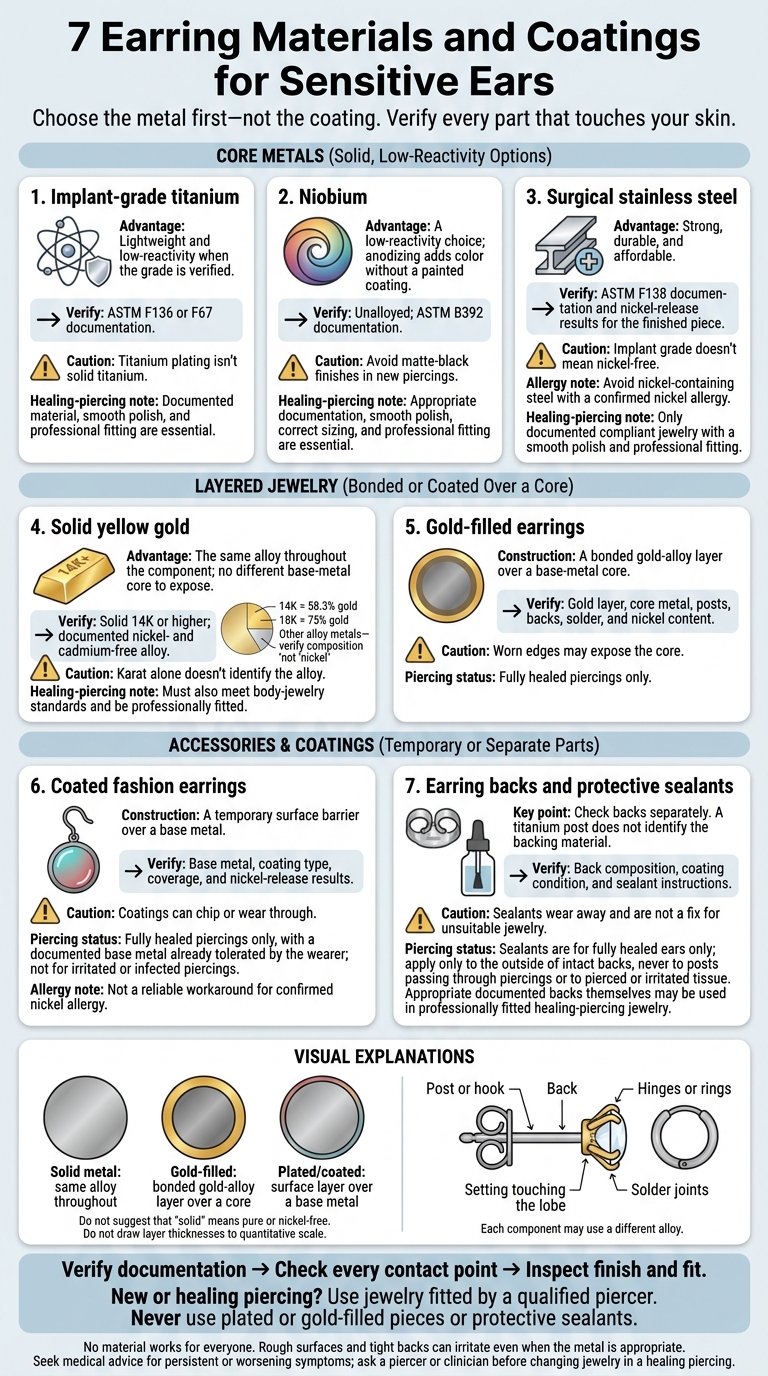
7 Earring Materials and Coatings for Sensitive Ears
Check Every Part of Your Earrings
Before comparing metals, check every part that can touch your skin. Start with the post or hook and backing, then look at decorative pieces that rest against your lobe, rings, hinges, and solder joints. Each part may use a different alloy. Ask the seller to identify them separately - a titanium post tells you nothing about the backing or solder.
For layered jewelry, check both the finish and the metal underneath. Solid metal means the same alloy runs through the entire component. It does not mean pure metal or guarantee that it’s nickel-free. Understanding the difference between gold-filled and gold-plated jewelry is essential, as gold-filled has a bonded layer while plating is thinner, while a barrier coating separates your skin from the base metal. Find out what that base metal is and whether exposed edges could touch your ear.
Inspect earrings under good lighting before putting them on. Look for flaking, exposed base metal, rough solder joints, scratches, and burrs. Posts should be straight, and backs should fit without squeezing your lobes. A smooth finish matters just as much as metal composition, especially while tissue heals.
New or healing piercings need jewelry fitted by a qualified piercer. Ask for titanium with documentation showing it meets ASTM F136 or F67, along with the right gauge and a smooth, polished finish. The Association of Professional Piercers says gold-plated and gold-filled jewelry are not appropriate for new or unhealed piercings.
Do not use fashion earrings or apply nail polish, glue, resin, or sealants to jewelry for healing piercings. Coatings can wear away or crack; they cannot make an unsuitable base metal safe for healing tissue. If you’re unsure about a piece, have a professional assess it rather than repeatedly swapping jewelry or adding another coating. Once you’ve checked the hardware, compare the core metal.
1. Implant-Grade Titanium
Once you’ve checked the post, back, and finish, titanium is often the safest starting point for sensitive ears - as long as the alloy is documented and the finish is smooth.
Titanium is lightweight, and its natural protective oxide layer helps it resist corrosion.
ASTM F136 titanium is a Ti-6Al-4V ELI alloy generally regarded as nickel-free for piercing use. “Medical-grade” is vague, so ask for ASTM F136 documentation rather than relying on the label.
Solid titanium stays titanium. Titanium plating can wear through and expose the base metal underneath. Anodized titanium, on the other hand, changes surface color without adding a coating.
For healed piercings, titanium remains a low-reactivity option. But tight backs, rough edges, and friction can still irritate your skin.
2. Niobium
Niobium is another low-reactivity metal to consider for sensitive ears.
Nickel Content and Release
Check every part that touches your skin - including posts, backs, hinges, and solder - for nickel exposure.
Material Grade and Documentation
Choose unalloyed niobium that meets ASTM B392, and ask for documentation confirming it. The Association of Professional Piercers (APP) accepts niobium for piercing jewelry when it has the right documentation.
Durability and Coating Wear
Anodizing changes niobium’s surface color without adding a coating that can flake off. Over time, friction may fade the color or expose the metal’s natural gray surface.
Healed Versus New Piercings
For healed earlobes, anodized niobium adds color without a painted finish. New piercings need correctly sized jewelry that can be sterilized and has a smooth, polished surface. Avoid matte-black niobium in new piercings: its color comes from heat treatment, not anodizing.
For a more familiar metal, compare surgical stainless steel next.
3. Surgical Stainless Steel
Steel costs less than many other jewelry metals, but sensitive ears need documented low-nickel grades. Skin safety depends on how much nickel the finished piece releases - not the “surgical” label alone.
Nickel Content and Release
Many stainless-steel alloys, including common 316L alloys, contain nickel. Ask for nickel-release test results for the finished piece, rather than relying on its alloy name.
Use European limits as a benchmark: under 0.2 µg/cm²/week for piercing posts and under 0.5 µg/cm²/week for prolonged skin contact. These limits don't guarantee that U.S. products meet them. If you have a confirmed nickel allergy, avoid nickel-containing steel.
Material Grade and Documentation
Request ASTM F138 certification, lot traceability, and nickel-release results for the finished piece. The Association of Professional Piercers accepts ASTM F138 steel with the right documentation for piercing jewelry. Labels such as 316L, medical-grade, or hypoallergenic aren't enough on their own.
Durability and Coating Wear
Polished, uncoated steel has no decorative layer that can flake off. Plating, however, can wear away at posts and edges, exposing the alloy underneath.
Stop wearing coated earrings if the finish chips or another metal shows through. Don't try to repair them with household polish or craft coating.
Healed Versus New Piercings
Documented steel can work for healed ears. For new piercings, use only ASTM F138-compliant steel with a smooth polish and proper fit. Have a piercer check the certification before insertion.
4. Solid Yellow Gold
After titanium, niobium, and steel, gold offers a familiar choice - but only when its alloy makeup is documented.
Nickel Content and Release
Solid yellow gold may contain nickel. Ask for written confirmation that it’s nickel-free. The gold label alone doesn’t tell you which other metals are present.
Karat and Alloy Documentation
14K is 58.3% gold, 18K is 75%, 22K is 91.7%, and 24K is nearly pure gold. Lower karats leave more room for other metals, including nickel.
A karat stamp tells you the gold content, not the full alloy makeup. Ask for supplier alloy information and a clear statement that the piece is both nickel-free and cadmium-free.
Durability and Coating Wear
Solid gold has the same alloy throughout the component, so normal wear won’t expose a different base metal. If you prefer a layered option, the next section covers gold-filled earrings.
Healed Versus New Piercings
For healed ears, documented nickel-free 14K or 18K yellow gold balances strength and purity. Smooth posts and secure closures matter just as much as karat.
For new piercings, the Association of Professional Piercers accepts solid 14K or higher yellow gold when it’s nickel- and cadmium-free and made to body-jewelry standards. gold-filled, plated, and gold vermeil jewelry is not suitable for healing piercings.
5. Gold-Filled Earrings
Gold-filled earrings fall between solid gold and plated fashion jewelry. They hold up better than plating, but they aren’t solid gold.
They have a bonded gold-alloy layer over a base-metal core, with the gold layer accounting for at least 5% of the total weight.
Nickel Content and Release
Gold-filled doesn’t mean nickel-free. Check the gold alloy, core, posts, backs, and solder for nickel, and ask for test documentation. Worn seams or edges can expose the core metal.
Material Documentation
For handcrafted earrings, ask for the post, backing, core-metal, gold-karat, and bonding specifications for the exact pair you’re buying. Confirm whether the gold layer is mechanically bonded or electroplated, and request its weight ratio or thickness.
Durability and Coating Wear
The bonded layer withstands wear better than ordinary plating, but friction and chemicals can still wear it down. Inspect seams and worn edges for exposed core metal. Skip abrasive polishing, and take the earrings off before swimming, showering, or applying fragrance.
Healed Versus New Piercings
Wear gold-filled earrings only in fully healed piercings, with documentation for every metal that touches your skin.
For lower-cost fashion jewelry, compare coated earrings next.
6. Coated Fashion Earrings
Protective lacquer and rhodium plating can reduce skin contact with the base metal. But neither proves that the metal underneath is nickel-free.
Treat coatings as a fallback for a documented base metal you already tolerate - not a replacement for skin-safe core metals. The post, backing, and edges are usually the weakest points.
| Coating | Protective role | Wear limitations | Verification needed |
|---|---|---|---|
| Protective lacquer | Forms a thin film that reduces direct contact with the base metal | Can scratch, peel, or wear away with sweat, friction, cleaning, and insertion; may leave edges and seams uncovered | Confirm the base metal, coverage, care instructions, and suitability for prolonged skin contact |
| Rhodium plating | Adds a bright surface layer that can delay skin contact with the base alloy | Friction at posts, clasps, and edges can expose the base metal | Verify the base alloy, nickel content, plating specifications, and suitability for pierced ears |
Nickel Content and Release
Rhodium-plated earrings can still contain nickel underneath. If you have a confirmed nickel allergy, choose a verified nickel-free material rather than testing an unknown coated pair on your skin.
Material Documentation
Ask whether the coating covers every point that touches your skin. Also request nickel-release results after wear testing. The backing and sealant matter just as much as the front finish.
Durability and Coating Wear
Check your earrings before each wear, especially around hinges, bends, and areas that touch your earlobes. Stop wearing them if you see flaking, rough patches, or exposed base metal. Replace the earrings or have a jeweler replate them.
Healed Versus New Piercings
Do not use coated fashion earrings, lacquer, or nail polish on new, healing, irritated, or infected piercings. Keep coated pairs for fully healed piercings, and only when the base metal is documented and you already tolerate it.
Stop wearing them if itching, burning, or a rash develops. Seek medical advice if symptoms persist or become severe.
A coated front doesn't protect you from an exposed post or backing. Wherever the coating fails, your skin can come into contact with the metal underneath.
7. Earring Backs and Protective Sealants
A skin-safe front doesn’t guarantee a skin-safe back. A coating on the front offers little help if the back rubs your ear raw.
Nickel Content and Release
A titanium post doesn’t make an unknown butterfly back safe. Check clutches, screws, hinges, and back coatings separately. Don’t rely on a “hypoallergenic” claim. Ask for nickel-release testing on the full back assembly. The back material matters just as much as the post.
Material Documentation
Ask for the exact back material: titanium, documented niobium, ASTM F138 steel, or nickel- and cadmium-free gold rated 14K or higher. Inspect the back for wear before every use.
Durability and Coating Wear
Friction inside a clutch can wear down a coating or sealant. Replace backs that are cracked, corroded, peeling, or rough. Sealants also wear out; replace them only as directed. They may help protect intact metal on healed ears, but never use them on new piercings.
Healed Versus New Piercings
For fully healed ears, apply sealants only to the outside of intact backs - never to posts that pass through piercings or to pierced or irritated tissue. For new piercings, use documented biocompatible jewelry. Get medical care if symptoms worsen or persist.
Compare Materials and Coatings
Coatings reduce contact with the base metal. They don’t change it. The table below compares metals, barrier coatings, and how they hold up with wear.
| Material or coating | Nickel-allergy suitability | Durability | Main advantage | Main limitation | Verification needed |
|---|---|---|---|---|---|
| Implant-grade titanium | Generally suitable with documentation | High; resists corrosion | Lightweight and biocompatible | “Titanium” alone doesn’t identify the grade | ASTM F136, ASTM F67, or ISO 5832-3 documentation |
| Niobium | Generally suitable when unalloyed and verified | High; resists corrosion | Can be colored through anodizing | Documentation may be missing | Unalloyed niobium; ASTM B392 documentation |
| Surgical stainless steel | Conditional; may contain nickel | High | Strong and affordable | Implant grade does not mean nickel-free | Exact alloy, ASTM F138 or ISO 5832-1, and nickel-release results |
| Solid yellow gold | Generally suitable when verified nickel- and cadmium-free | Durable; higher karats are softer | No base-metal core | Karat doesn’t identify the alloy metals | Solid 14K or higher; nickel- and cadmium-free alloy |
| Gold-filled earrings | Conditional | Moderate to high while intact | Costs less than solid gold | Worn edges can expose the core | Core metal, gold proportion, nickel content, and contact-surface coverage |
| Coated fashion earrings | Not reliable for confirmed nickel allergy | Varies | Adds a temporary contact barrier | Coating can chip or wear away | Base metal, coating type, coverage, and nickel-release results |
| Earring backs and sealants | Depends on the back metal and sealant | Varies | Covers backs and closures | Sealants offer only temporary protection | Back composition, sealant compatibility, and reapplication guidance |
Suitability depends on the alloy, coating condition, and wear time. If you have a known or suspected metal allergy, choose documented materials and avoid damaged coatings. Consult a dermatologist for persistent or severe reactions.
Earring Selection Checklist
Use this checklist before you buy, wear, or reuse any pair. Documentation matters as much as the metal itself.
- Check every skin-contact point: Inspect the post, hook, back, setting, hinge, and jump ring for rough edges, burrs, scratches, flaking, or trapped polishing compound.
- Request documentation for the exact pair you plan to wear. Don’t rely on a “hypoallergenic” label alone. Verify ASTM F136 titanium, ASTM B392 niobium, ASTM F138 or ISO 5832-1 stainless steel, or solid 14K+ yellow gold that’s nickel- and cadmium-free.
- Inspect before each wear. Reject earrings with chipped plating, worn-through coating, or exposed base metal. Avoid plated and gold-filled jewelry in new or healing piercings.
- Stop wearing earrings that cause itching, burning, redness, swelling, pain, or a rash. Seek medical care if symptoms persist or you notice signs of infection: discharge, severe pain, spreading redness, or fever. For a new or healing piercing, ask a qualified piercer or clinician for guidance before removing or changing jewelry.
FAQs
How can I tell a metal allergy from irritation?
A metal allergy can cause redness, itching, a rash, dry patches, or blisters where jewelry touches your skin. Symptoms usually develop gradually and start to improve soon after you remove the jewelry.
Redness and swelling can also point to an infection, often caused by bacteria entering a new piercing. Discharge or fever may signal a serious infection. A dermatologist can use a skin patch test to confirm a metal allergy.
How can I verify an earring’s material certification?
The term “hypoallergenic” isn’t federally regulated in the United States, so read product descriptions carefully and ask the seller for certifications or third-party test results. Labels such as “Certified Nickel Free” or “Certified Nickel Safe” indicate formal testing.
You can also use an at-home nickel spot test kit to check your earrings for nickel.
How do I know my piercing is fully healed?
A piercing is considered fully healed when there’s no redness, swelling, soreness, or bleeding. If irritation, discharge, or discomfort while wearing jewelry persists, the piercing may still be healing or reacting to the jewelry material.
Redness and swelling can also point to a metal reaction or possible infection. Choose biocompatible metals, such as titanium or niobium, to support healing and help avoid skin sensitivities.