Skip to content




Top 12 Royal Engagement Rings of All Time
Royal engagement rings are more than jewelry - they're symbols of history, love, and legacy. From Princess Diana's iconic sapphire ring, now worn by Catherine, Princess of Wales, to Meghan Markle's custom trilogy ring with diamonds from Botswana and Princess Diana's collection, these rings blend elegance with personal stories. Here's a quick look at the most famous royal engagement rings:
- Catherine, Princess of Wales: 12-carat sapphire surrounded by diamonds, originally chosen by Princess Diana.
- Queen Elizabeth II: A 3-carat diamond solitaire crafted with stones from a Romanov tiara.
- Meghan, Duchess of Sussex: A trilogy ring featuring a Botswana diamond and two stones from Diana's jewelry.
- Grace Kelly: A 10.48-carat emerald-cut diamond, a Hollywood icon turned royal treasure.
- Princess Eugenie: A rare padparadscha sapphire with a diamond halo.
- Queen Máxima of the Netherlands: An orange diamond symbolizing the House of Orange.
- Crown Princess Mary of Denmark: A diamond flanked by ruby baguettes, reflecting Denmark's flag.
- Queen Letizia of Spain: A sleek white gold band with baguette diamonds.
- Princess Charlene of Monaco: A 3-carat pear-shaped diamond with tapered baguettes.
- Queen Consort Camilla: An Art Deco emerald-cut diamond from the Queen Mother's collection.
- Princess Anne: Two sapphire rings - one tri-stone and one with a diamond cluster.
- Princess Beatrice: A vintage-inspired diamond ring with Art Deco and Victorian elements.
These rings are not just beautiful - they're steeped in meaning, showcasing personal connections, royal heritage, and timeless design. Below is a comparison table summarizing their key features.
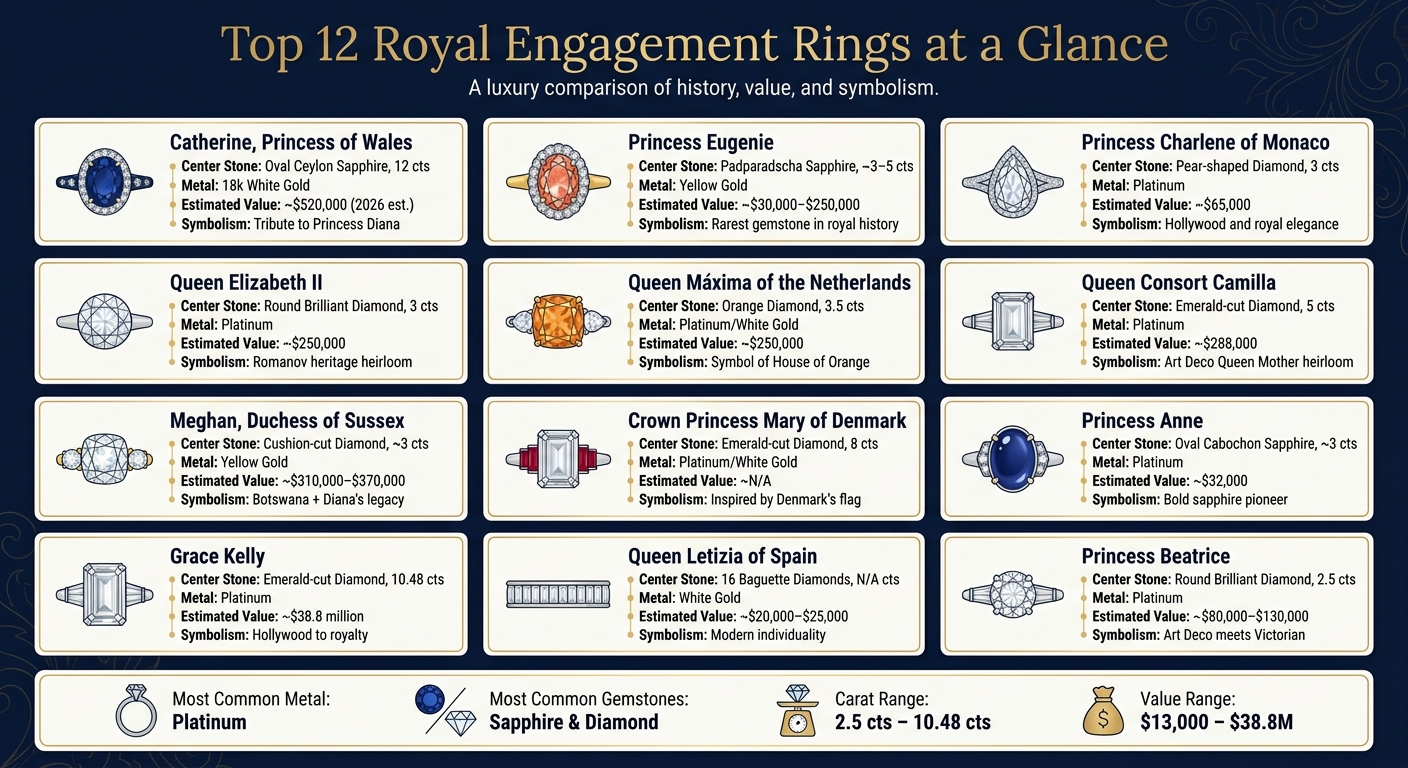
Top 12 Royal Engagement Rings: Stones, Carats & Values Compared
Quick Comparison Table
| Royal Wearer | Center Stone | Carat Weight | Metal | Setting Style | Symbolism |
|---|---|---|---|---|---|
| Catherine, Princess of Wales | Oval Ceylon Sapphire | 12 cts | 18k White Gold | Cluster (14 diamonds) | Tribute to Princess Diana |
| Queen Elizabeth II | Round Brilliant Diamond | 3 cts | Platinum | Solitaire with pavé shoulders | Diamonds from Prince Philip's mother's tiara |
| Meghan, Duchess of Sussex | Cushion-cut Diamond | ~3 cts | Yellow Gold/Micro-pavé | Trilogy (3 stones) | Center stone from Botswana; side stones from Diana's collection |
| Grace Kelly | Emerald-cut Diamond | 10.48 cts | Platinum | Solitaire with baguettes | Transition from Hollywood to royalty |
| Princess Eugenie | Padparadscha Sapphire | ~3-5 cts | Yellow Gold | Halo with diamonds | Rare gemstone; inspired by Sarah Ferguson's ring |
| Queen Máxima of the Netherlands | Orange Diamond | 3.5 cts | Platinum/White Gold | Interlocking bands | Represents the House of Orange |
| Crown Princess Mary | Emerald-cut Diamond | 8 cts | Platinum/White Gold | Flanked by ruby baguettes | Inspired by Denmark's flag |
| Queen Letizia of Spain | Baguette Diamonds | - | White Gold | Eternity-style band | Modern design reflecting individuality |
| Princess Charlene of Monaco | Pear-shaped Diamond | 3 cts | Platinum | Tapered baguettes | Inspired by Hollywood and royal elegance |
| Queen Consort Camilla | Emerald-cut Diamond | 5 cts | Platinum | Art Deco (3 baguettes/side) | Heirloom from Queen Mother's collection |
| Princess Anne | Sapphire | ~3 cts | Platinum | Tri-stone/Cluster | Personal style with historical influence |
| Princess Beatrice | Round Brilliant Diamond | 2.5 cts | Platinum | Vintage-inspired with baguettes | Combines Art Deco and Victorian elements |
These rings continue to inspire modern designs, proving that elegance and meaning can coexist in timeless pieces.
1. Catherine, Princess of Wales – Sapphire Heirloom Once Worn by Diana
This engagement ring is more than just a piece of jewelry - it’s steeped in history and emotion. At its heart lies a 12-carat oval-cut Ceylon blue sapphire, encircled by 14 round-cut solitaire diamonds, all set in 18-karat white gold. The design takes inspiration from a sapphire-and-diamond brooch that Prince Albert commissioned for Queen Victoria in 1840, which she famously wore as her "something blue" on her wedding day.
What makes this ring stand out is its origin. Unlike most royal engagement rings, which are typically custom-made, Diana chose this one directly from the Garrard catalog in 1981. This decision broke with tradition and reflected her desire to craft her own path within the royal family. Stellene Volandes, Editor-in-Chief of Town & Country, remarked, "The ring is in keeping with Diana's insistence of creating her own narrative within the royal family". Decades later, this sentiment carried forward into another royal love story.
When Prince William proposed to Catherine Middleton during a trip to Kenya in November 2010, he did so with this same ring. He explained his choice by saying:
"It's my mother's engagement ring, so I thought it was quite nice because, obviously, she's not going to be around to share in any of the fun and excitement of all this. This is my way of keeping her sort of close to it all."
To ensure the ring fit Catherine’s finger without altering its original band, royal jewelers G. Collins & Sons added small platinum beads to the inside. This discreet adjustment preserved the ring’s original structure while making it wearable - a thoughtful touch that kept its legacy intact.
The ring’s value has skyrocketed over time. Initially priced between $37,500 and $60,000 at the time of Diana's engagement, its estimated worth is projected to reach $520,000 by 2026. Beyond its monetary value, the ring has left a lasting mark on both royal traditions and luxury jewelry trends. Garrard even incorporated the design into their "1735" collection, featuring pieces priced from $8,500 to $150,000. Claire Scott, Design and Development Director at Garrard, highlighted its significance: "The iconic sapphire cluster design... has become synonymous with Garrard, inspiring the creation of many bespoke engagement ring designs for the royal family and other clients".
| Feature | Specification |
|---|---|
| Center Stone | 12-carat oval Ceylon sapphire |
| Side Stones | 14 round-cut solitaire diamonds |
| Metal | 18-karat white gold |
| Jeweler | Garrard |
| Original Cost | ~$37,500–$60,000 (1981) |
| Estimated Value | ~$520,000 (2026) |
2. Queen Elizabeth II – Classic Diamond Solitaire With a Hidden Meaning
Queen Elizabeth II's engagement ring is the perfect example of timeless elegance. Designed by Prince Philip in collaboration with London jeweler Philip Antrobus Ltd. on Bond Street, the ring features a 3-carat round brilliant-cut diamond as its centerpiece. This is complemented by 10 smaller pavé-set diamonds - five on each side - all nestled in a platinum setting.
What makes this ring truly special is its origin story. Prince Philip sourced the diamonds from a tiara that belonged to his mother, Princess Alice of Battenberg. The tiara itself was a wedding gift from Tsar Nicholas II and Tsarina Alexandra of Russia. Given Philip's high profile, he couldn’t simply walk into the jeweler’s unnoticed, so Princess Alice personally delivered the diamonds to Philip Antrobus Ltd. Reflecting on the finished ring, Princess Alice remarked:
"I think the ring is a great success." – Princess Alice of Battenberg
The proposal and ring announcement were shrouded in secrecy. King George VI delayed the official news until Elizabeth's 21st birthday, leaving the ring hidden for nearly a year before it was unveiled in July 1947. On the morning of the announcement, it was revealed that the ring was slightly too large for Elizabeth’s finger - she hadn’t been able to attend a fitting without raising suspicion.
This ring not only became a symbol of Elizabeth and Philip's enduring love but also influenced engagement ring trends. Its platinum solitaire design helped set the round brilliant-cut diamond as the gold standard for engagement rings. Additionally, the concept of repurposing heirloom stones into custom designs gained popularity - a tradition Prince Harry later embraced. The Court Jeweller captured its essence perfectly, calling it: "Romanov diamonds grand enough for a monarch, but a simple design suited for a woman who preferred country pursuits".
Elizabeth cherished this ring throughout her life, wearing it for an incredible 75 years, from 1947 until her passing in 2022.
| Feature | Specification |
|---|---|
| Center Stone | 3-carat round brilliant-cut diamond |
| Side Stones | 10 pavé-set diamonds (5 per side) |
| Metal | Platinum |
| Jeweler | Philip Antrobus Ltd. (now Pragnell) |
| Original Cost | ~$15,000 (1947) |
| Estimated Value | ~$250,000 |
3. Meghan, Duchess of Sussex – Trilogy Diamond Ring With a Botswana Center Stone
When Prince Harry proposed to Meghan Markle in November 2017, he chose a ring rich in personal meaning. Designed by Prince Harry himself and crafted by Cleave & Company - Queen Elizabeth II's trusted jeweler - the ring features a cushion-cut center diamond of about 3 carats, sourced from Botswana. This location holds special significance for the couple, as it was where they shared their first vacation together, camping under the stars shortly after meeting. Unlike the solitaire style of Queen Elizabeth II's ring or Catherine, Princess of Wales's sapphire cluster, Meghan's ring combines sentimental milestones with royal tradition, offering a modern take on legacy.
Flanking the center diamond are two smaller round diamonds from Princess Diana's personal jewelry collection, a heartfelt tribute ensuring that Harry’s late mother remains part of their journey. During their engagement interview, Prince Harry explained:
"The little diamonds on either side are from my mother's jewelry collection to make sure that she's with us on this crazy journey together." – Prince Harry
Meghan also shared her feelings about the ring:
"It's incredibly special to be able to have this, which sort of links where [Harry comes] from and Botswana, which is important to us. It's perfect." – Meghan, Duchess of Sussex
The ring’s design evolved over the years. Initially set on a solid yellow gold band, it was updated in 2019 with a slimmer micro-pavé diamond band, and a hidden halo detail was added in 2022. These changes not only refreshed its look but also increased its value - from an estimated $200,000 at the time of their engagement to between $310,000 and $370,000 today.
This ring has captured global attention. As of 2024, it is the most-searched celebrity engagement ring worldwide, averaging 51,283 searches per month. In 2023 alone, it garnered 586,000 Google searches, far surpassing the interest in Kate Middleton's sapphire ring, which had less than one-seventh the search volume that year. It also reignited interest in trilogy-style engagement rings, a design last seen in a prominent British royal engagement when Sophie, Duchess of Edinburgh, received hers in 1999. Meghan’s ring stands as a remarkable blend of tradition and modernity, reflecting both personal history and royal heritage.
| Feature | Original Design (2017) | Updated Design (2019–Present) |
|---|---|---|
| Center Stone | ~3-carat cushion-cut (Botswana) | ~3-carat cushion-cut (Botswana) |
| Side Stones | Two round diamonds (Diana's collection) | Two round diamonds (Diana's collection) |
| Band | Solid yellow gold | Thin micro-pavé diamond band |
| Additional Details | Simple trilogy setting | Hidden halo added (2022) |
| Estimated Value | ~$200,000–$260,000 | ~$310,000–$370,000 |
4. Grace Kelly, Princess of Monaco – Two Engagement Rings, Including a Large Emerald Cut
Grace Kelly's engagement rings are a perfect blend of royal charm and cinematic allure. Interestingly, she is the only royal on this list to have received not one but two engagement rings, each with its own story and significance.
When Prince Rainier III proposed in December 1955, he first gave her a Cartier eternity band featuring alternating rubies and diamonds. This design was no coincidence - it symbolized the red and white colors of Monaco's flag. While meaningful, this wasn't the ring that would later capture the world's attention.
Soon after, Rainier took it up a notch by commissioning another ring from Cartier. This time, it was a showstopper: a 10.48-carat emerald-cut diamond, flanked by two tapered baguette-cut diamonds, all set in platinum. This ring made its Hollywood debut when Kelly wore it during the filming of her final movie, High Society. In fact, Prince Rainier replaced a planned prop ring with the real Cartier diamond, giving it a starring role alongside Kelly.
As Pierre Rainero, Cartier's Director of Image, Heritage, and Style, once remarked:
"Unwilling to remove the ring, Grace Kelly wore it in her last film, High Society, giving it a full-fledged role."
The ring quickly became a global sensation, even before Kelly's royal wedding in April 1956, which was viewed by an estimated 30 million people. Initially appraised at $4.06 million in 1956, its current value is estimated at $38.8 million.
Grace Kelly's emerald-cut design set the standard for modern engagement rings. Its timeless combination of a high-clarity center stone with baguette diamonds on a platinum band has inspired countless others, including Amal Clooney, Anne Hathaway, and Beyoncé. Both of Kelly's rings remain part of the House of Grimaldi's collection, serving as enduring symbols of royal sophistication and Hollywood glamour.
| Feature | First Ring (Dec 1955) | Second Ring (1956–Present) |
|---|---|---|
| Jeweler | Cartier | Cartier |
| Center Stone | Alternating rubies & diamonds | 10.48-carat emerald-cut diamond |
| Side Stones | Eternity band style | Two tapered baguette-cut diamonds |
| Metal | Gold | Platinum |
| Symbolism | Colors of the Monaco flag | Hollywood glamour and royal elegance |
| Estimated Value | - | ~$38.8 million |
5. Princess Eugenie of York – Padparadscha Halo Ring
In January 2018, Jack Brooksbank proposed to Princess Eugenie during a sunset in Nicaragua, presenting her with a ring that featured a stunning padparadscha sapphire as its centerpiece.
Padparadscha sapphires are among the rarest gemstones in the world, admired for their soft salmon-pink-orange tones and their pleochroic nature, meaning the color shifts depending on the light. The name "padparadscha" comes from the Sinhalese term for "lotus blossom", and these gems are primarily sourced from Sri Lanka. This rare and exquisite stone became the focal point of a ring design that artfully combined uniqueness with royal tradition.
Brooksbank personally selected the sapphire, and together with Princess Eugenie, designed a ring that highlighted its beauty. The setting features an oval padparadscha sapphire (weighing an estimated 3–5 carats) surrounded by a halo of 10–12 round brilliant diamonds, flanked by two pear-shaped diamonds on a yellow gold band. The design pays homage to Eugenie's mother, Sarah Ferguson, whose 1986 engagement ring also featured a cluster setting, but with a red Burmese ruby as the centerpiece. Brooksbank explained his choice of the stone with heartfelt words:
"Why I loved it so much is it changes color from every different angle that you look at it, which is what I think of Eugenie. She changes color, and it's just so amazing."
The ring's value is estimated to range between $30,000 and $250,000, depending on the quality and origin of the sapphire. Gem-quality padparadscha sapphires alone are valued at approximately $10,000–$50,000 per carat. Following the engagement announcement, the ring sparked a surge in interest for these rare gemstones. As Niveet Nagpal, President of Omi Gems & Omi Privé, noted:
"Most people don't know about colored gemstones and especially what a padparadscha sapphire is, so Princess Eugenie's engagement will be a great start to getting the information out there and driving people to specifically ask for it."
Much like the "Kate Middleton effect" that drove a spike in sapphire demand in 2010, Princess Eugenie's ring created a similar wave of interest, putting fancy-colored sapphires in the spotlight and influencing market trends.
6. Queen Máxima of the Netherlands – Orange Diamond Tied to the House of Orange
When King Willem-Alexander proposed to Máxima Zorreguieta on January 19, 2001, during an ice-skating outing at Huis ten Bosch, the engagement ring immediately drew attention for its striking and meaningful design. Created by the Dutch jeweler Steltman, the ring's centerpiece is a rare oval-cut orange diamond, symbolizing the House of Orange-Nassau and Willem-Alexander's title as Prince of Orange.
At 3.5 carats, the orange diamond is flanked by two emerald-cut white diamonds, all set within two rows of pavé-set diamonds. The ring's design features three interlocking bands, crafted in platinum or white gold, giving it a layered and intricate appearance. These details not only enhance its visual appeal but also emphasize its connection to Dutch heritage.
Maxwell Stone, Creative Director at Steven Stone, highlighted the significance of this choice:
"An orange centre stone is an unusual choice, but certainly a meaningful one as orange is the colour of the Netherlands, making it the perfect shade for the royal bride."
Orange, the national color of the Netherlands, symbolizes pride and unity. Pure orange diamonds are among the rarest gemstones, ranking just behind pink and blue diamonds, which adds to the ring's exclusivity. Valued at approximately $250,000, the ring also reflects Máxima's personal and cultural ties. She alternates the hand on which she wears it, honoring her Catholic upbringing and King Willem-Alexander's Protestant traditions.
7. Crown Princess Mary of Denmark – Emerald Cut With Ruby and Diamond Side Stones
Crown Prince Frederik created this stunning ring to represent the colors of Denmark's national flag, the Dannebrog. Featuring a central white diamond flanked by red ruby baguettes, the ring is a symbolic tribute to Mary’s new home. As Jess Ilse, Assistant Editor at Royal Central, explained:
"For a future Queen of Denmark, an engagement ring inspired by the flag of her new home country was the choice of her groom."
The centerpiece is an impressive 8-carat emerald-cut diamond, set in platinum or white gold, with ruby baguettes on either side. The couple announced their engagement on October 8, 2003, after meeting during the 2000 Summer Olympics in Sydney - a romance that quickly captured global attention.
Later on, Mary updated the ring’s original design by adding two diamonds to frame the rubies. This thoughtful addition is said to represent their four children: Prince Christian, Princess Isabella, Prince Vincent, and Princess Josephine.
This patriotic design left a lasting impression within the Danish Royal Family. In 2008, Prince Joachim proposed to Marie Cavallier with a ring inspired by the French Tricolore. Beyond its royal significance, the design also influenced broader jewelry trends, steering attention toward mixed-gemstone rings that carry personal and cultural meaning, moving away from traditional all-diamond solitaires.
8. Queen Letizia of Spain – White Gold Band With Baguette Diamonds
When then-Prince Felipe of Spain announced his engagement to Letizia Ortiz on November 1, 2003, their engagement came with a ring that stood out for its unconventional design. Created by Suárez, a Spanish jewelry house, the ring broke away from the traditional royal engagement styles.
Instead of featuring a prominent center stone, the ring is a sleek white gold band set with 16 baguette-cut diamonds arranged vertically. Its design is reminiscent of a high-end eternity band, with an estimated value of $20,000–$25,000. Kathryn Money, Vice President of Strategy and Merchandising at Brilliant Earth, described the ring:
"Queen Letizia's non-traditional ring doesn't include a center diamond or gemstone. Instead, her sophisticated band features 16 vertically set baguette-cut diamonds in a platinum- or white-gold setting."
The ring reflected Letizia's individuality at the time. As a well-known broadcast journalist, a commoner, and a divorcee, she represented a modern and unconventional choice for a future queen. Jewelry historian Zuleika Gerrish summed up her style with this observation:
"She treats jewelry as information rather than embellishment: repetition is deliberate, restraint is strategic, and omission can be the most powerful statement of all."
Interestingly, since around 2012, Queen Letizia has rarely been seen wearing this ring. Diamond expert Maxwell Stone noted her explanation: "as she has to meet a lot of dignitaries every day, the ring hurts her hand due to the endless handshaking". These days, she often opts for a simpler gold-plated ring by designer Karen Hallam. This shift highlights her preference for understated and practical jewelry, reinforcing her modern approach to royal traditions.
9. Princess Charlene of Monaco – Pear Cut Diamond With Tapered Baguettes
When Prince Albert II of Monaco announced his engagement to Charlene Wittstock on June 23, 2010, it was a notable moment in Monaco's history. It marked the first engagement of a ruling prince since Prince Rainier III proposed to Grace Kelly in 1956.
The ring, custom-designed by Repossi - Monaco's official jeweler - features a stunning 3-carat pear-shaped diamond. This centerpiece is flanked by smaller diamonds in a tapered baguette arrangement, creating a striking combination. Jewelry stylist Jason Rembert shared his thoughts on this style:
"Personally, I've always favored pear-shaped diamond engagement rings, as they are just more unique than your typical oval and round cuts. Also, you get way more bang for your buck with a pear-cut diamond because of its elongated shape; it looks much bigger than a round solitaire."
The design's brilliance lies in its balance. The geometric lines of the tapered baguettes contrast beautifully with the soft curves of the pear-shaped diamond. Interestingly, this design draws inspiration from the ring Frank Sinatra gave Mia Farrow in 1966 - a 9-carat pear-shaped diamond with tapered baguettes - connecting Princess Charlene's ring to a legacy of both Hollywood and royal elegance.
While understated compared to other royal rings, its estimated value of $65,000 reflects a refined and thoughtful approach to design. Despite its allure, Princess Charlene is rarely seen wearing the ring, often opting for her 18-carat white gold Cartier wedding band instead. This choice highlights her preference for simplicity while still honoring the timeless appeal of her engagement ring.
The pear cut itself has seen a major resurgence in popularity. Jewelry expert and author Marion Fasel remarked:
"Pear-shaped diamond rings, once a grand dame in jewelry, are staging an epic comeback in the engagement and commitment ring arena."
Today, the pear cut is highly sought after for engagement rings, admired for its ability to appear larger than its carat weight and its graceful, elongated shape on the finger. This timeless design continues to inspire modern trends, blending historical charm with contemporary elegance.
10. Queen Consort Camilla – Art Deco Ring With a Large Central Diamond
When King Charles III and Queen Camilla announced their engagement on February 10, 2005, the ring Camilla wore carried with it a legacy that extended far beyond their special moment.
The ring is a true Art Deco treasure, believed to date back to the 1920s or 1930s. It features a striking 5-carat emerald-cut diamond at its center, set in platinum, and flanked by three baguette-cut diamonds on each side. Its geometric design and clean symmetry are hallmarks of the Art Deco era. Jewelry expert Nilesh Rakholia, Founder of Abelini, described its unique charm:
"Its long facets and step cuts create a 'hall of mirrors' effect that emphasizes clarity and purity, rather than overt sparkle, a decision that aligns perfectly with Camilla's elegance and understated regal presence."
The ring’s history is just as captivating as its design. It once belonged to the Queen Mother, King Charles's grandmother, and is believed to have been part of the Greville collection. This collection was a significant jewelry bequest left to the Queen Mother by Dame Margaret Greville in 1943. Historian Gareth Russell highlighted the sentimental significance behind the ring:
"Proposing with a ring from her collection may have been a way to honor the late Queen Mother."
By choosing this family heirloom over a newly designed piece, the couple emphasized continuity and a deep connection to royal heritage. The ring’s combination of historical importance and Art Deco style bridges the past with the present, blending tradition with timeless design.
Today, the ring is valued at an estimated $288,000. Like many royal engagement rings, it showcases masterful craftsmanship paired with a rich history. Kate Earlam-Charnley, Design Director at Taylor & Hart, noted how its architectural design perfectly complements Camilla’s "understated yet regal aesthetic". This timeless appeal continues to influence modern jewelry trends, with emerald-cut diamonds in Art Deco settings remaining a favorite among style icons like Beyoncé and Amal Clooney.
11. Princess Anne – Classic Sapphire and Diamond Cluster Ring
Princess Anne's engagement rings stand out for their elegance and personal touch, each offering a unique spin on classic designs. Over the years, she has been associated with two sapphire rings, both of which reflect her distinctive style.
The first, presented by Captain Mark Phillips in 1973, features a timeless tri-stone design. Crafted by Garrard & Co., it showcases a faceted sapphire at the center, flanked by two diamonds. As Princess Anne succinctly described it:
"You see, it's pretty simple. A sapphire in the middle and a diamond on each side."
Her second ring, gifted by Sir Timothy Laurence before their December 1992 wedding at Crathie Kirk, takes a more intricate approach. This piece features a 3-carat oval cabochon sapphire surrounded by clusters of three small diamonds, giving it a slightly bohemian flair.
Back in 1973, Anne’s choice of a sapphire as the centerpiece was seen as unconventional, breaking away from the traditional white diamond solitaire. Bailey Bujnosek of InStyle noted:
"The choice to feature a blue sapphire over a classic white diamond, as well as three stones over a solitaire, made Anne's ring a standout from the start."
This bold decision not only set her apart but also influenced later royal engagement ring trends, proving how individual preferences can subtly reshape tradition.
While modestly valued - her first ring is estimated at $13,000 and the second at $32,000 - these rings carry a significance far beyond their price tags. Princess Anne's love for sapphires has become a hallmark of her style, linking her choices to a broader legacy of royal elegance that continues to resonate today.
12. Princess Beatrice – Vintage-Inspired Diamond Ring With Tapered Sides
Princess Beatrice's engagement ring is a stunning blend of Art Deco charm and Victorian sophistication. When her husband, Edoardo Mapelli Mozzi, collaborated with designer Shaun Leane, the goal was to merge his love for Art Deco with Beatrice's Victorian style. The result? A timeless yet modern masterpiece. The custom platinum band features a 2.5-carat round brilliant diamond at its center, framed by two tapered baguette-cut diamonds, each weighing approximately 0.75 carats.
Shaun Leane described his creative process:
"I fused the two eras to create a ring with a Victorian silhouette and tapered baguette‐cut side stones to create a linear, Art Deco effect."
The tapered baguette sides add an architectural elegance, while six delicate prongs - designed in Leane’s signature "talon" style - enhance the brilliance of the central diamond. Importantly, all the diamonds were ethically sourced from Botswana.
The design process was meticulous. Leane spent four months and sketched 40–50 concepts before finalizing the ring. Experts estimate its value to be around $80,000, with some appraisals reaching as high as $130,000.
Princess Beatrice’s choice of an all-diamond design marks a departure from the recent trend of colored gemstones seen in royal rings, such as Kate Middleton's sapphire and Princess Eugenie’s padparadscha sapphire. Instead, her ring reflects a growing preference for antique-inspired, bespoke designs that carry deeper personal significance.
"Being able to incorporate both Edoardo and Princess Beatrice's characters into the design has resulted in a ring that symbolizes their intertwined lives." – Shaun Leane
This ring, like others in the royal family, is more than just a piece of jewelry - it tells a story of personal connection while honoring royal tradition.
Comparison Table
Each ring tells a story through its gemstone, metal, and design, blending personal significance with timeless craftsmanship. Here's a detailed comparison of the featured royal rings:
| Royal Wearer | Center Stone | Carat Weight | Metal | Setting Style | Symbolism |
|---|---|---|---|---|---|
| Catherine, Princess of Wales | Oval Ceylon Sapphire | 12 cts | 18k White Gold | Cluster (14 diamonds) | Tribute to Princess Diana and enduring loyalty |
| Queen Elizabeth II | Round Brilliant Diamond | 3 cts | Platinum | Solitaire with pavé shoulders | Diamonds from Prince Philip's mother's tiara (Romanov heritage) |
| Meghan, Duchess of Sussex | Cushion-cut Diamond | ~3 cts | Yellow Gold / Micro-pavé | Trilogy (3 stones) | Center stone from Botswana; side stones from Diana's collection |
| Grace Kelly | Emerald-cut Diamond | 10.48 cts | Platinum | Solitaire with tapered baguettes | Transition from Hollywood to royalty |
| Queen Consort Camilla | Emerald-cut Diamond | 5 cts | Platinum | Art Deco (3 baguettes per side) | Heirloom from the Queen Mother's collection |
These rings highlight the interplay of aesthetics, heritage, and symbolism, making each one a royal icon in its own right.
Interestingly, platinum emerges as a preferred metal for Queen Elizabeth II, Grace Kelly, and Queen Consort Camilla, while Catherine’s ring is set in 18k white gold, and Meghan’s design initially featured yellow gold. Sapphires and diamonds dominate the choices, reflecting long-standing royal traditions.
While carat weights vary - ranging from Grace Kelly's impressive 10.48-carat emerald-cut diamond to Queen Elizabeth II's modest 3-carat solitaire - the true value of these rings lies in their personal and historical significance. For instance, Queen Elizabeth II's ring, originally valued at $15,000 in 1947, is now estimated at $250,000. Meanwhile, Grace Kelly’s ring is believed to be worth an astonishing $38.8 million today.
Above all, the most meaningful aspect of these rings is their connection to family and history. Whether it’s diamonds repurposed from Prince Philip’s mother’s tiara or stones linked to Princess Diana, these pieces transcend luxury to become treasured family heirlooms.
Conclusion
A few clear trends emerge when examining these 12 royal engagement rings. Colored gemstones - like sapphires, rubies, and emeralds - are just as prominent as diamonds, challenging the assumption that royals always favor the traditional choice. As Vogue pointed out, "It's interesting, then, how few British royals have marked their engagements with the traditional gem, with sapphires, emeralds, and rubies just as common." Additionally, halo and cluster settings remain iconic in royal jewelry, while three-stone trilogy rings have seen a surge in modern popularity.
What makes these rings truly special isn’t their monetary value but the deep meaning they carry. Each stone tells a story, representing cherished memories and emotional connections. Prince William perfectly encapsulated this sentiment when he proposed to Kate Middleton with Princess Diana's ring, saying, "This was my way of keeping her memory close."
These timeless designs continue to inspire jewelry trends today. The "Diana" sapphire cluster and the "Grace Kelly" emerald-cut solitaire remain popular choices for custom creations. Sapphires, in particular, hold symbolic ties to loyalty, truth, and abundance - qualities that resonate far beyond royal circles.
The appeal of these historic rings goes beyond tradition. That same sense of meaningful design and craftsmanship is at the core of what LaCkore Couture offers. By blending symbolism, natural stones, and exceptional artistry, their USA-made pieces celebrate individuality - proving that timeless elegance and personal significance belong to everyone, not just royalty.
FAQs
Which royal engagement ring is the most valuable today?
Grace Kelly’s Cartier engagement ring takes the crown as the most expensive royal engagement ring ever. This stunning piece features a 10.48-carat emerald-cut diamond, flanked by two baguette-cut diamonds, and is valued at an astonishing $38.8 million.
While other royal rings, such as Kate Middleton’s iconic sapphire ring, carry immense historical and sentimental significance, their monetary value doesn’t come close. For instance, Kate’s sapphire ring is estimated at around $520,000, making Grace Kelly’s dazzling diamond the unrivaled leader in terms of financial worth.
Why do so many royals choose sapphires or other colored gemstones?
Royals have long been drawn to sapphires and other colored gemstones, largely because of their rich historical roots and symbolic meaning. Sapphires, especially, are linked to qualities like wisdom, loyalty, and nobility - traits that resonate deeply with royal tradition. Many royal rings take cues from legendary heirlooms, such as the sapphire-and-diamond brooch that Prince Albert gave Queen Victoria in 1840. This timeless piece set the stage for the enduring royal love affair with vibrant, colored stone jewelry.
How are royal engagement ring values estimated over time?
Experts determine the value of royal engagement rings by analyzing several factors, including the quality of materials, gemstone characteristics (such as cut, carat weight, and rarity), and their historical significance. While initial assessments focus on craftsmanship and the cost of materials, the value often increases over time due to inflation, shifting market trends, and the sentimental or historical weight associated with the ring's owner. Many of these rings feature heirloom gemstones or reflect a rich cultural heritage, making exact valuations difficult and often placing them in a category beyond monetary worth.