Skip to content




Best Polishing Compounds for Jewelry Buffing
Polishing jewelry isn’t just about making it shine - it protects metals and gemstones from wear and tear. The right polishing compound can remove scratches, restore luster, and safeguard your pieces. Here’s a quick breakdown of the top compounds and what they’re best for:
- Tripoli: Removes deep scratches; leaves a satin finish on gold, silver, and brass.
- Jeweler’s Rouge: Perfect for a mirror-like shine on gold jewelry.
- Zam: Gentle enough for silver and soft gemstones like turquoise.
- Green Rouge: Ideal for hard metals like platinum and stainless steel.
- Blue Platinum: Designed for platinum, delivering a bright finish without over-polishing.
- Fabulustre: A one-step solution for light scratch removal and polishing.
- White Diamond: Balances abrasiveness for intermediate polishing of gold, silver, and more.
Quick Comparison
| Compound | Best For | Purpose | Finish |
|---|---|---|---|
| Tripoli | Gold, Silver, Brass | Remove scratches | Satin/Matte |
| Jeweler’s Rouge | Gold | Final polish | High-gloss mirror |
| Zam | Silver, Soft Gemstones | Gentle polishing | High luster |
| Green Rouge | Platinum, Stainless Steel | Final polish | Brilliant mirror |
| Blue Platinum | Platinum, White Gold | Final polish | Bright reflective |
| Fabulustre | Gold, Silver | Scratch removal + polish | Mirror-like |
| White Diamond | Gold, Silver, White Metals | Intermediate polishing | Semi-gloss |
Choosing the right compound depends on your jewelry’s material and the finish you want. Start with a coarse compound like Tripoli to remove scratches, then move to finer options like Rouge or Fabulustre for a polished shine. Always clean pieces between steps to avoid residue buildup. Proper polishing not only enhances beauty but also extends the life of your treasured jewelry.
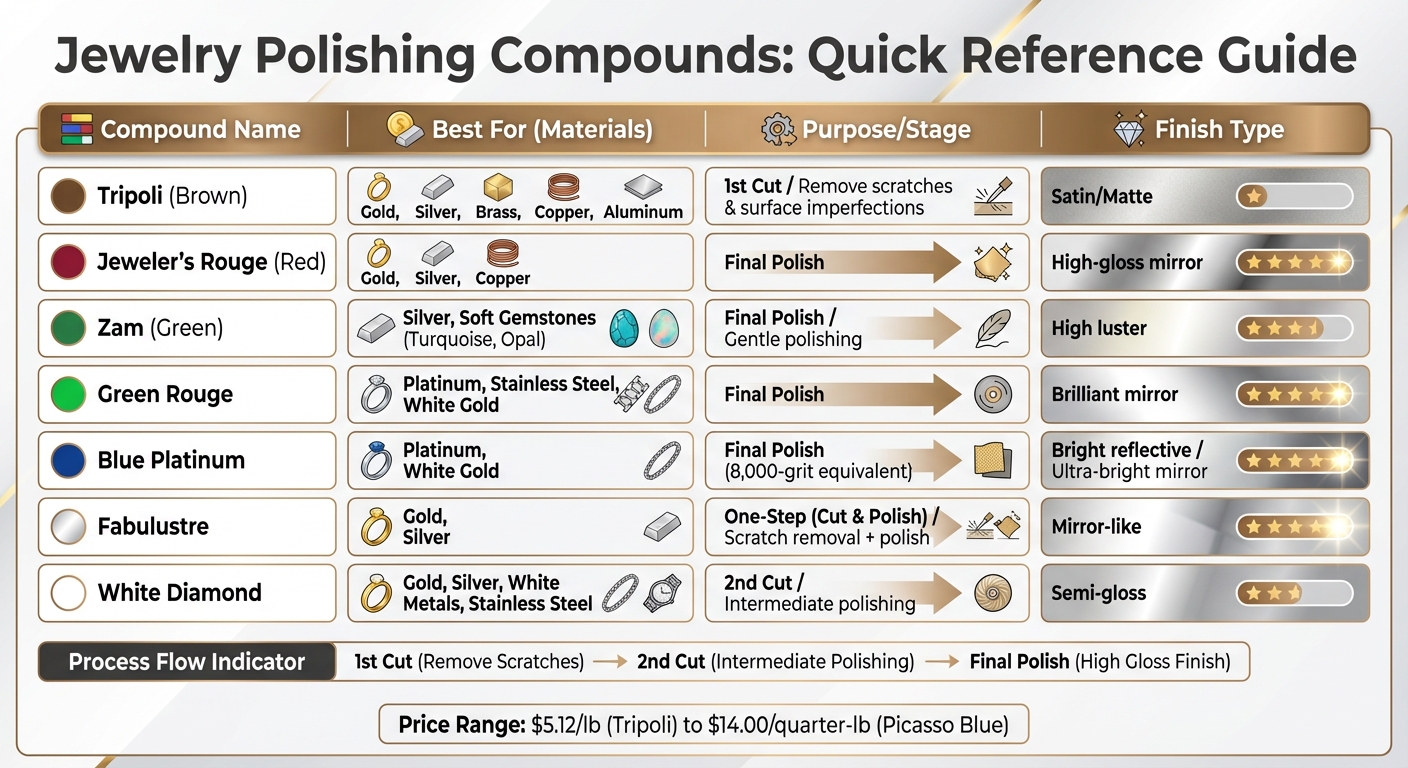
Jewelry Polishing Compounds Comparison Guide: Best Uses and Finishes
Types of Polishing Compounds
Selecting the right polishing compound is all about matching the compound to your specific goal - whether you're tackling deep scratches or aiming for that perfect mirror-like finish. Each compound is formulated with unique abrasives and binders, designed for particular tasks. Making the right choice not only restores the shine but also helps maintain the fine details of your handcrafted jewelry.
Tripoli Compound
Tripoli is a coarse polishing compound made from crushed quartz or siliceous rock. It's highly effective for removing scratches, pits, and oxidation from non-ferrous metals like gold, silver, brass, and copper. While Tripoli smooths out the surface, it leaves a matte or satin finish - not the high-gloss shine you'd want for the final step.
Jeweler's Rouge
Known as red rouge, this compound is made from fine ferric oxide grains and is perfect for achieving a high-gloss, mirror-like finish, particularly on yellow gold. During polishing, gold jewelry absorbs some of the ferric oxide, which enhances its brightness. As John Fisher explains:
"Rouge, is French for 'red', and even though it is then semantically incorrect to call green or white polishing compound rouge, we do it anyway".
Zam Compound
Zam is a proprietary blend of aluminum and chrome oxides and is a go-to choice for polishing both metals and natural stones like turquoise and jade. This compound is especially useful for jewelry that combines gemstones with metal, as it can polish both without causing damage or leaving behind heavy residue. Its finish isn’t the deepest "black" mirror shine, but this can actually help mask minor scratches.
Green Rouge
Formulated with chrome oxide, green rouge is ideal for final polishing on harder metals such as stainless steel, platinum, and chrome. It delivers a brilliant luster while remaining minimally abrasive. However, the concentration of chrome oxide can vary significantly between manufacturers - ranging from 5% to 90% - which means results can differ depending on the brand you choose.
Blue Platinum Compound
This compound is specifically designed for platinum and other hard metals. It creates a bright, reflective finish without causing over-cutting. Platinum requires specialized compounds like this because using compounds meant for gold can cause the metal to "flow" or ripple instead of polishing properly.
Fabulustre
Fabulustre is a multi-purpose, high-luster compound that uses alumina as its polishing agent. It delivers a mirror-like finish on a variety of metals without removing much material, making it ideal for delicate handcrafted items. Acting as a one-step solution, it can remove light scratches while providing a high-gloss finish, saving time compared to the traditional two-step Tripoli-and-Rouge process.
White Diamond Compound
White Diamond is a semi-gloss compound made from tin oxide or alumina. It strikes a balance between Tripoli and rouge in terms of abrasiveness - gentler than Tripoli but coarser than rouge. This makes it suitable for removing light scratches from gold, silver, and even delicate materials like ivory or bone, without leaving a colored tint. Depending on the formulation, the particle size of aluminum oxide "A" can be as fine as 0.3 microns, while "B" can go down to 0.05 microns.
Polishing Compound Comparison
Selecting the right polishing compound depends on your jewelry's material and the finish you want to achieve. The process typically follows three stages: cutting (removing scratches with coarse compounds), intermediate polishing (smoothing the surface), and final polishing (achieving a high-gloss shine). This step-by-step approach ensures professional results while safeguarding delicate, handcrafted jewelry.
For gold, Red Rouge is ideal for the final polish, while Zam is a gentler option for silver pieces with soft gemstones, reducing the risk of scratches. If you're looking for simplicity, Fabulustre offers a one-step solution, combining light scratch removal with polishing.
Harder metals like stainless steel and platinum require more abrasive compounds. Green Rouge delivers a brilliant mirror finish on stainless steel, while Blue Platinum (equivalent to 8,000-grit) is specifically designed for platinum and white gold. Using the wrong compound on platinum can cause issues like rippling or metal flow, so choosing the right product is critical. Below is a summary of the key compounds and their uses:
Polishing Compound Comparison Table
| Compound Type | Compatible Materials | Polishing Stage | Key Benefits |
|---|---|---|---|
| Tripoli (Brown) | Brass, Copper, Aluminum, Gold | 1st Cut / Pre-polishing | Removes scratches and surface imperfections |
| Jeweler's Rouge (Red) | Gold, Silver, Copper | Final Polish | Produces a high-gloss, mirror-like finish; non-aggressive |
| Zam (Green) | Silver, Soft Gemstones (Turquoise, Opal) | Final Polish | Safe for stones; leaves no residue; high luster |
| Green Rouge | Stainless Steel, Platinum, White Gold | Final Polish | Creates a mirror finish for hard metals; minimal abrasiveness |
| White Diamond | Stainless Steel, Silver, White Metals | 2nd Cut / Intermediate | Removes light scratches; provides a semi-gloss finish |
| Blue Platinum / Picasso Blue | Platinum, Silver, White Gold | Final Polish | 8,000-grit equivalent; delivers an ultra-bright mirror finish |
| Fabulustre | Gold, Silver | One-Step (Cut & Polish) | Combines scratch removal and polishing in one step |
The cost of these compounds varies widely. For instance, Tripoli costs around $5.12 per pound, while high-end options like Picasso Blue are priced at approximately $14.00 for a quarter-pound bar . While the upfront expense may differ, investing in the right compound ensures better results and protects your handcrafted pieces in the long run.
How to Choose the Right Polishing Compound
What to Consider When Selecting a Polishing Compound
When picking a polishing compound, the hardness of the material you're working with should be your first focus. Softer metals like gold and silver respond best to finer rouges, while tougher materials such as platinum or stainless steel require more aggressive options like green rouge or specialized platinum compounds. If you're dealing with mixed metal and stone pieces, Zam is a great choice because it polishes gently yet effectively.
The stage of the polishing process also plays a big role. Polishing typically starts with "cutting", where coarse compounds like Tripoli remove scratches, and ends with "final polishing", which uses fine compounds like Rouge to create a high shine. Make sure to clean your jewelry thoroughly between stages using warm soapy water or an ultrasonic cleaner to avoid grit contamination.
The compound base is another factor to consider, especially for intricate, handcrafted pieces. Wet compounds cut faster but can be messy, while dry compounds allow for more precision and easier cleanup. For items with delicate patterns or engravings, dry compounds are ideal as they help maintain sharp edges.
Also, keep separate buffing wheels for different metals to prevent cross-contamination. Pair your mops with the right compounds - harder stitched muslin works well for cutting stages, while softer materials like flannel or chamois are better for achieving that final, high-luster finish.
Once you've chosen the right compound, proper polishing and maintenance will ensure your jewelry maintains its shine.
Care Tips for Handcrafted Jewelry
After polishing, it's crucial to remove any residue. Use warm soapy water for this step, but for pieces with sensitive stones like pearls or opals, skip the ultrasonic cleaner and opt for a soft toothbrush to clean detailed areas. Change the direction of your polishing frequently to avoid creating uneven surfaces, especially on softer metals. Be cautious around V-shaped or sharp corners - polishing directly into these areas can round off crisp edges or recessed designs. For gold and silver, using compounds like Zam can help resist handling marks and "case burn", keeping the finish intact for longer periods.
When applying the compound, press the bar gently against a spinning wheel. The heat from friction will melt just enough compound onto the buff - there's no need to manually moisten or heat it. Always prioritize safety by wearing respirators and eye protection when working with rotary motors and polishing compounds to avoid inhaling dust or debris.
Conclusion
Using the right polishing compound can completely transform jewelry, taking it from lackluster to brilliantly reflective. But polishing isn’t just about looks - it also creates a protective barrier against oxidation. By smoothing the metal surface in a directional way, polishing aligns ions, which makes it tougher for acids and salts to penetrate and cause tarnishing. This not only keeps your jewelry shining but also extends its lifespan.
This level of care is central to LaCkore Couture's dedication to quality. Every piece - from gold necklaces to silver bracelets adorned with natural stones - is meticulously handcrafted with premium materials. Regular polishing ensures these designs maintain their stunning appearance. As jeweler William Pellegrini puts it:
"I usually hear 'It did not look this good the day I bought it' from my customers".
The key to achieving this brilliance lies in selecting the right compounds. A three-stage process - cutting, buffing, and final polishing - helps preserve delicate details while avoiding contamination.
You don’t need professional equipment to incorporate polishing into your jewelry care routine. Understanding compound particle sizes allows you to choose the appropriate product for quick touch-ups. For deeper maintenance, follow a guide on how to clean silver jewelry to remove stubborn tarnish. After polishing, storing your jewelry in airtight, anti-tarnish bags helps protect the finish from humidity and sulfur gases.
FAQs
What’s the safest compound for jewelry with gemstones?
When working with jewelry that features gemstones, it’s important to choose a polishing compound that’s gentle enough for delicate materials. Zam is an excellent choice because it can polish softer stones effectively without risking scratches. However, always double-check that the compound is compatible with the specific gemstones in your piece to ensure their safety and preservation.
What order should I use compounds for scratch removal to final shine?
To get that high-gloss finish, here’s what you need to do:
- Begin with a coarse compound, such as brown Tripoli. This helps eliminate deep scratches and surface flaws.
- Move on to a medium-grade compound, like white rouge, to refine the surface and smooth it out.
- Wrap it up with a fine polishing compound, such as jeweler's rouge, to achieve a mirror-like shine.
Working step-by-step from coarse to fine compounds is the key to achieving the best results.
How do I avoid cross-contaminating my buffing wheels?
To avoid cross-contamination, always keep your polishing compounds separate and clean your buffing wheels regularly. Mixing buffs for rouge and tripoli can compromise the quality of your polish, so stick to dedicated tools for each compound. Store your buffs and compounds in separate containers, and use a wheel rake to get rid of trapped particles. For a more thorough clean, try a hot water solution with ammonia or even ultrasonic cleaning. Just make sure your wheels are completely dry before using them again.