Skip to content




Aztec Jewelry Motifs in Gold and Silver
Aztec jewelry was more than decoration - it symbolized power, spirituality, and identity. Crafted from gold and silver, these pieces showcased advanced techniques like lost-wax casting and featured motifs such as eagles, serpents, and sun symbols. Each design carried deep meaning, from representing divine authority to embodying transformation or cosmic cycles. Reserved for nobility and priests, these ornaments reflected status and connection to the gods.
Key highlights:
- Gold as "sweat of the sun" symbolized divine energy.
- Eagles and suns represented strength and leadership.
- Serpents and jaguars conveyed transformation and warrior status.
- Common designs included pectorals, ear spools, and necklaces, often adorned with jade, turquoise, or shells.
Today, modern artisans reinterpret these motifs using traditional techniques, blending ancient symbolism with contemporary styles. Whether through bold statement pieces or minimalist designs, Aztec-inspired jewelry continues to honor its origins while offering personal expression.
Key Aztec Motifs and Their Meanings
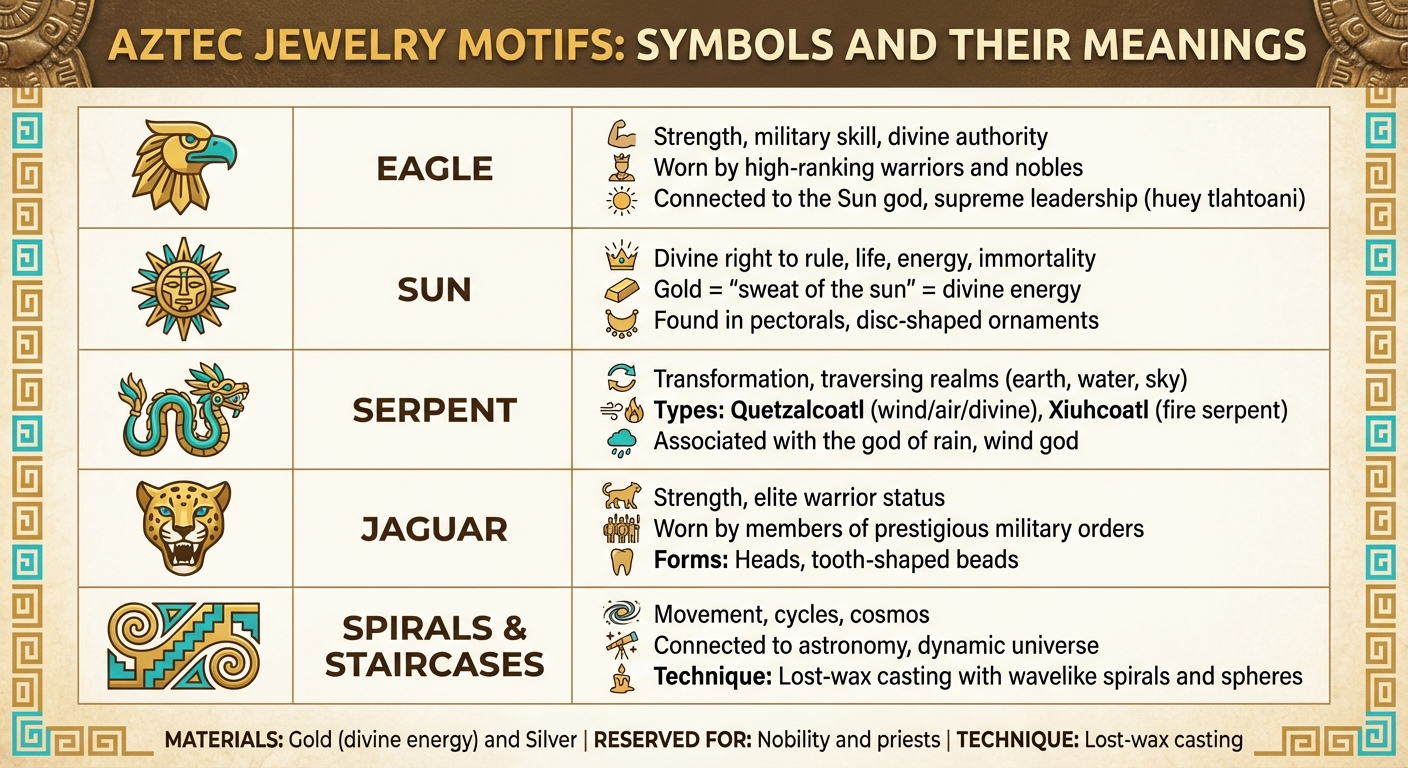
Aztec Jewelry Motifs: Symbols and Their Meanings in Gold and Silver
Aztec artisans didn’t just create jewelry; they crafted pieces rich with spiritual and symbolic depth. By combining mythology, nature, and craftsmanship, they infused their creations with meanings that reflected the Aztecs’ understanding of power, transformation, and the link between the earthly and divine realms. Gold and silver, considered sacred materials, became the perfect canvas for these profound motifs.
Eagle and Sun Motifs
In Aztec culture, the eagle stood as a powerful emblem of strength, military skill, and divine authority. High-ranking warriors and nobles often wore eagle-shaped labrets, marking their elevated status and their connection to the sun god. This connection also tied them to the concept of the huey tlahtoani, or "great speaker", a title symbolizing supreme leadership.
Sun motifs, often crafted into gold pectorals or disc-shaped ornaments, carried immense meaning. They underscored the ruler’s divine right to lead and reinforced gold’s sacred link to life, energy, and immortality. These celestial symbols, along with intricate patterns and animal imagery, told layered stories through the jewelry’s design.
Spirals and Staircases
Geometric designs like spirals and staircases were more than decorative - they symbolized movement, cycles, and the cosmos itself. These patterns mirrored the Aztecs’ deep understanding of astronomy and the dynamic nature of the universe. A standout example is the serpent labret housed at The Met, which features a basal plug adorned with wavelike spirals and tiny spheres. This piece highlights the mastery of Aztec goldsmiths, who utilized advanced lost-wax casting techniques to achieve such intricate designs.
Animal Symbols: Jaguars and Serpents
Animals held a special place in Aztec symbolism, with jaguars and serpents being among the most prominent. The jaguar, a symbol of strength and elite warrior status, appeared in jewelry as heads or beads shaped like jaguar teeth. These pieces identified wearers as members of prestigious military orders.
Serpents, on the other hand, represented transformation and the ability to traverse between realms - earth, water, and sky. Archaeologist Leonardo López Luján explains their importance:
"Serpents are not a bad omen... For the Mexica, they're associated with the god of rain... they're also associated with Quetzalcoatl, who commands the wind."
Different types of serpents carried unique meanings. Quetzalcoatl, the feathered serpent, symbolized wind, air, and divine connection, while Xiuhcoatl, the fire serpent, was seen as the animated weapon of the sun god Huitzilopochtli. Aztec goldsmiths showcased their skill by creating serpent jewelry with incredible detail - some even had movable tongues that swung as the wearer moved. These animal motifs weren’t just decorative; they conveyed profound ideas about power, transformation, and the wearer’s role in Aztec society.
Classic Aztec Jewelry Pieces
Pectorals and Necklaces
Pectorals, the ornate chest pieces, were powerful symbols of authority in Aztec society. These elaborate ornaments, along with items like ear spools, reflected the intricate motifs central to Aztec culture. Worn by the nobility during major religious and state events, these pieces showcased their connection to divine favor. Crafted from materials like gold, turquoise, and shells, pectorals often featured solar designs symbolizing the wearer's link to the gods.
Necklaces, on the other hand, added an auditory element to their visual appeal. Many included what archaeologists describe as "small, jangling bells" - gold or copper ornaments shaped like flower buds that created sound with movement. As Professor Karl Taube from the University of California, Riverside, points out:
"Aztec jewelry often was heard as much as it was seen".
Some necklaces also featured the Ehecacozcatl, or "wind jewel", a pendant made from a cross-sectioned conch shell associated with Quetzalcoatl, the wind god. Reserved for the elite, these pendants were worn during private ceremonies and served as a mark of status. Together, these necklaces and pectorals laid the groundwork for other status-defining accessories like bracelets and ear spools.
Bracelets, Anklets, and Ear Spools
To complement the grandeur of pectorals, smaller accessories like bracelets and anklets played a significant role in defining Aztec identity. Often adorned with small bells, these pieces added a rhythmic sound to ritual dances and ceremonial processions. The jingling sounds reinforced their wearers' elite status during these events.
Ear spools, however, stood out as one of the most distinctive elements of Aztec jewelry. These funnel-shaped discs were designed to stretch the earlobe, serving as a visible mark of high status. Made from materials such as gold, stone, or pottery, ear spools were typically worn by men of nobility. Over time, the weight of these ornaments elongated the earlobe, creating a permanent and unmistakable symbol of prestige.
Modern Jewelry Inspired by Aztec Motifs
Combining Ancient Motifs with Contemporary Styles
Drawing from the rich history of Aztec culture, modern jewelry designers are breathing new life into ancient symbols, blending them with contemporary aesthetics. These designs often reinterpret traditional Aztec motifs, creating pieces that feel both timeless and current. A key technique in this process is the traditional lost-wax casting method, a practice that has remained largely unchanged since its documentation in the Codex Florentino. This method allows artisans to craft intricate details in gold and silver jewelry, preserving the artistry of the past while adapting it for today's tastes.
In Taxco, Mexico, a hub for fine jewelry, artisans continue this legacy with stunning creations. From minimalist "Aztec Eye" pendants to bold feathered serpent designs, these pieces are crafted using sterling silver (.925) and 14k or 18k gold. Modern designs tend to follow two distinct paths: sleek, geometric forms for a minimalist look or dramatic, statement pieces inspired by the grandeur of ancient Aztec pectorals. Both styles maintain the symbolic depth of Aztec traditions, making them meaningful for today’s wearers.
Take, for example, the sacred Quetzalcoatl, or feathered serpent. This iconic symbol is reimagined in a variety of forms, from delicate charm necklaces to bold leather-and-silver combinations. These pieces are enhanced with modern techniques like diamond-cutting and oxidation, which add a touch of sparkle or a vintage patina, creating a balance between old and new.
Angel Ortiz, a contemporary artisan celebrated for his Aztec-inspired designs, captures the passion behind this craft:
"Being an artisan is exciting, fun and motivational for me. I know that I'll see results are in proportion to my efforts and that motivates me to be a better person everyday." - Angel Ortiz, Artisan and Jewelry Designer
Brands such as LaCkore Couture also draw heavily from this tradition, offering handcrafted gold and silver pieces that merge ancient symbolism with modern fashion. Their collections emphasize quality craftsmanship, making these designs accessible to wearers who appreciate both cultural heritage and personal style. This modern approach has also paved the way for greater personalization in jewelry.
Customization and Personal Expression
Aztec jewelry has always been rooted in storytelling, and today’s customizable options allow wearers to create pieces that reflect their own personal narratives. Modern jewelry platforms have made it easier than ever to connect with Aztec symbolism in deeply personal ways. Birthstones, engraved glyphs, and deity charms can all be incorporated into designs, ensuring that each piece carries a unique meaning. For instance, sterling silver Aztec calendar pendants are often paired with personalized name charms in 14k gold. Adjustable bracelets also offer mix-and-match styling, featuring symbolic elements that resonate with the wearer.
Customization doesn’t stop at design elements - it extends to materials and finishes as well. High-end pieces may include Guatemalan jadeite inlays, a nod to the ancient practice of embedding stones, while more affordable options use gold-dipped or plated metals. This range of choices allows wearers to honor the spiritual narratives of Mesoamerica while expressing their individuality. Whether selecting a hummingbird (Huitzitzilin) to symbolize energy and the sun, or the God of Death (Miquiztli) to represent transformation, each piece carries both ancient wisdom and personal significance. This blend of tradition and self-expression ensures that Aztec-inspired jewelry continues to captivate modern audiences.
Conclusion
Aztec motifs crafted in gold and silver continue to captivate modern audiences, carrying layers of symbolic meaning. Gold often represents divine energy, while animal and celestial designs link wearers to ancient spirituality. For many descendants of the Aztecs and the people of Mexico, these motifs are more than just decorative - they serve as a powerful connection to cultural identity and pride, keeping alive a history that endured conquest and still inspires creativity today.
Modern jewelers honor these ancient symbols by using traditional techniques like lost-wax casting, filigree, and repoussé. These methods ensure that the artistry remains true to its origins, creating pieces that seamlessly blend the ancient with the contemporary. This preservation of craftsmanship forms a bridge between the past and present, allowing wearers to carry a piece of history with them.
"For the descendants of the Aztecs and people of Mexico, Aztec jewelry represents an important cultural heritage. It is a reminder of a rich and complex history, a source of pride, and an inspiration for cultural and artistic expression." - Ad Astra Jewelry
If you're considering adding Aztec-inspired jewelry to your collection, look for quality indicators like .925 stamps for sterling silver or 14k markings for gold to ensure the materials are genuine. Brands such as LaCkore Couture combine ancient symbolism with modern craftsmanship, offering pieces that celebrate both cultural heritage and personal style.
Whether symbolizing power, spirituality, or sacred energy, Aztec motifs in gold and silver transform jewelry into wearable stories. These designs are more than accessories - they’re timeless connections to one of Mesoamerica's most influential civilizations.
FAQs
How did Aztec artisans create their intricate gold and silver jewelry?
Aztec artisans mastered extraordinary techniques to create breathtaking gold and silver jewelry. One standout method was lost-wax casting - a process where they sculpted a wax model, encased it in clay, melted the wax away, and poured molten metal into the mold. This resulted in intricate, three-dimensional designs. They also hammered metal into delicate sheets and engraved complex patterns, showcasing an impressive level of detail and skill.
Beyond metals, they worked with hard stones like jade, turquoise, and obsidian. Using abrasive grinding tools, they shaped these materials into polished surfaces and intricate designs, creating pieces that were not only visually striking but also rich with meaning.
Modern brands, such as LaCkore Couture, pay homage to these ancient techniques. By incorporating lost-wax casting and hand-engraving into their gold and silver collections, they merge the artistry of the past with contemporary design sensibilities.
How are Aztec motifs used in modern gold and silver jewelry designs?
Modern artisans are bringing Aztec motifs into contemporary jewelry by merging ancient designs with modern techniques. Drawing inspiration from the Aztecs' love for materials like gold and silver, they use methods such as engraving, lost-wax casting, and hammering to craft pieces featuring iconic symbols like the sun god Tonatiuh, the calendar stone, and the feathered serpent Quetzalcoatl.
These age-old designs are transformed into sleek, wearable pieces like pendants, bracelets, and rings, making them ideal for everyday style. Brands such as LaCkore Couture pay homage to these historic motifs with handcrafted, customizable jewelry that blends traditional Aztec artistry with modern aesthetics, offering pieces that are both meaningful and fashionable.
What do animals like eagles and serpents represent in Aztec jewelry designs?
In Aztec jewelry, eagles and serpents held profound meaning, reflecting the values and beliefs of their society. The eagle symbolized strength, bravery, and its connection to the sun, making it a representation of warriors and divine power. On the other hand, the serpent stood for transformation, renewal, and vitality, often tied to Quetzalcoatl, one of the most significant deities in Aztec mythology.
These designs were not just spiritually important but also highlighted the Aztecs' exceptional craftsmanship and their deep respect for nature. Even today, these iconic motifs influence modern jewelry, merging ancient symbolism with contemporary style.