Skip to content




Arts and Crafts Movement in Jewelry: Guide
Arts and Crafts jewelry is hand-made jewelry that puts skill, simple materials, and design ahead of factory perfection or high stone prices. Its main period ran from about 1890 to 1920, starting in Britain and then moving into the United States and Europe.
If you want the short answer, here it is:
- I’d define Arts and Crafts jewelry by visible handwork
- It often uses silver, copper, enamel, pearls, and semi-precious stones
- Common motifs include flowers, leaves, vines, and other nature forms
- It grew as a reaction against machine-made sameness
- It differs from Art Nouveau by leaning more on craft process and less on surface drama
- Today, its ideas still show up in studio jewelry, custom work, and small-batch pieces
A few fast facts help frame it:
- The term was in use by 1887
- Jewelry from the movement reached its high point from 1890–1920
- Many pieces favor design over material cost, which means a stone’s look could matter more than its market price
- Surface clues like hammer marks, slight irregularity, and hand-set stones are often part of the appeal, not flaws
If I were checking a piece fast, I’d look for these signs first:
| Check | What it may mean |
|---|---|
| Visible tool marks | Made by hand, not factory-finished |
| Soft or uneven finish | Workshop work rather than machine uniformity |
| Silver or copper | Focus on design instead of status metal |
| Muted stones or enamel | Material chosen for color and fit |
| Nature motifs | Common style of the movement |
One more point matters: looks alone do not prove age. A piece can look Arts and Crafts and still be a later revival or reproduction, so marks, paperwork, and expert review still matter.
Below, the article explains the movement’s history, main ideas, makers, materials, style clues, and why its hand-made approach still matters now.
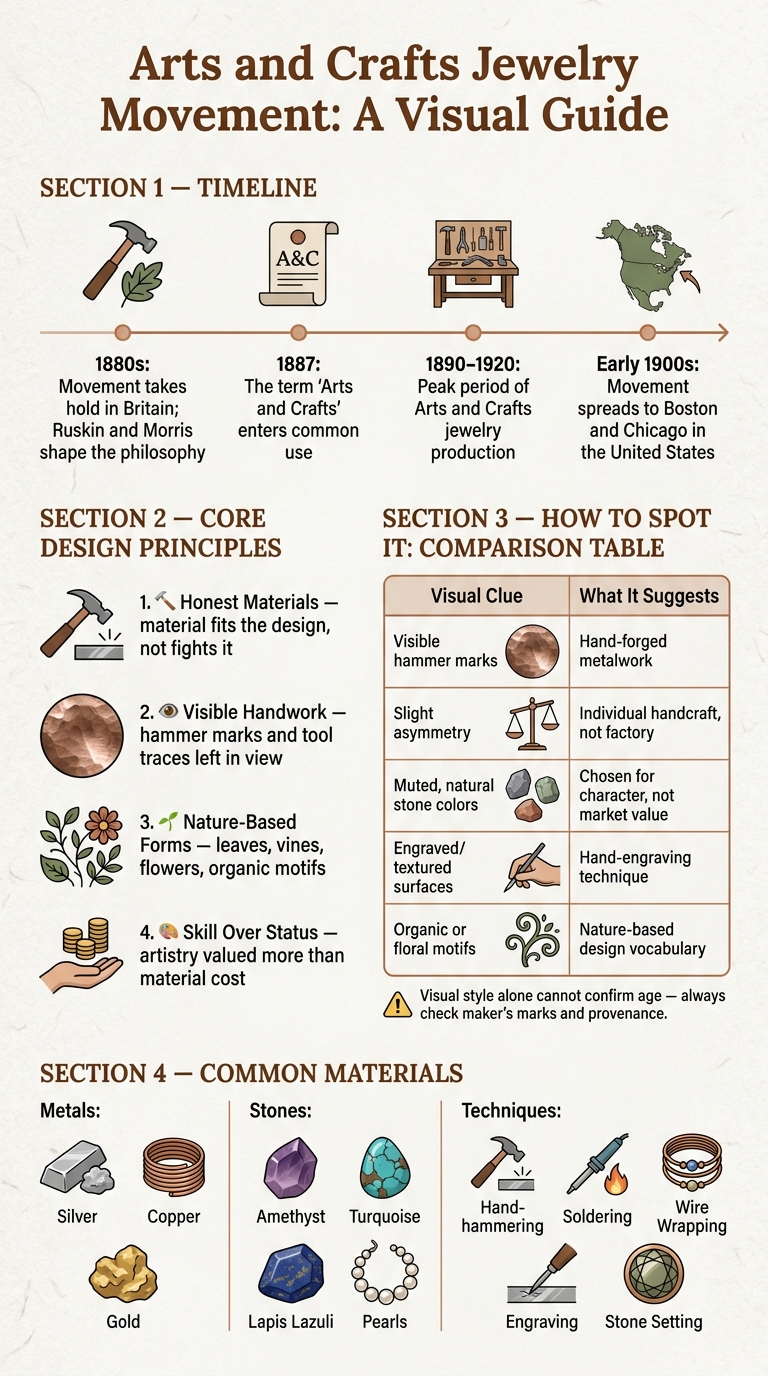
Arts and Crafts Jewelry Movement: History, Key Traits & Visual Guide
History and Core Ideas Behind the Movement
That look wasn’t just about style. It came from a reform-minded view of art, labor, and daily life. John Ruskin and William Morris gave the movement its main ideas, arguing that craft could serve as a moral and artistic answer to industrial society.
John Ruskin, William Morris, and the Anti-Industrial Mindset
John Ruskin and William Morris shaped this philosophy in direct ways. Their influence led makers away from factory-made jewelry and toward hand-made work where skill stayed out in the open. For jewelers, those beliefs didn’t remain abstract. They turned into a working design code.
The Main Design Principles
The design rules grew straight out of that philosophy. A few ideas shaped the look and feel of Arts and Crafts jewelry:
- Honest materials: the material should fit the design, not fight it.
- Visible handwork: hammer marks, solder lines, and hand-setting were left in view.
- Nature-based forms: leaves, vines, flowers, and other organic motifs appeared again and again.
- Value in skill, not status: artistry mattered more than the price or rarity of the materials.
Timeline: From British Origins to the American Spread
Those ideas soon moved from theory into workshop practice. By the 1880s and 1890s, the movement had taken hold in Britain. By the early 1900s, makers in Boston and Chicago had begun shaping those same ideas to fit local tastes in the United States.
Leading Makers, Jewelry Centers, and Regional Styles
As the movement spread, workshops in different regions took its core ideas and gave them their own spin.
Workshop-Based Making
Arts and Crafts jewelry was often made in dedicated workshops, where the whole setup favored slow, careful handwork. That hands-on approach meant each piece came out a little different, which was part of the appeal.
As the movement traveled, local materials and workshop customs shaped regional styles, even as handcraft stayed at the heart of the work.
Those regional differences show up more clearly in the named makers and studios that follow.
Materials, Techniques, and How to Spot Arts and Crafts Jewelry
Common Materials and Hand Techniques
You can often spot workshop-made Arts and Crafts jewelry by looking at the materials first. Many makers leaned toward copper, silver, and gold, and they usually left the surface fairly plain so the hand of the maker stayed visible.
Stones were picked for their color and personality, not just for price or sparkle. Amethyst, turquoise, lapis lazuli, pearls, and, now and then, shells show up often.
The work itself mattered just as much as the materials. Hand-hammering, soldering, forging, stone setting, wire wrapping, and engraving all played a big part. These methods tend to leave behind little signs of hand labor on the finished piece, which is often exactly the point.
Recurring Design Themes and Signs of Handcraft
Nature shaped much of the look. Organic forms and floral motifs appear again and again, giving many pieces a softer, more handmade feel.
When you examine a piece, pay attention to the small things: slight irregularities, tool marks, engraved areas, and finishes that aren't perfectly even. That kind of imperfection can tell you a lot. Machine-made jewelry usually looks too uniform. Arts and Crafts work often has a bit more life in it.
Beginner Checklist and Style Comparison Table
If you're new to this style, a quick visual scan can tell you a lot. Check for hand-finished texture, muted colors, and clear signs of handwork. Small irregularities, visible tool marks, and details that feel handmade instead of factory-made are all good clues.
| What to look for | What it suggests |
|---|---|
| Visible hammer marks or tool traces | Hand-forged metalwork |
| Uneven finishing or slight asymmetry | Individual handcraft, not factory production |
| Muted, natural stone colors | Material chosen for character, not market value |
| Engraved or textured surfaces | Hand-engraving technique |
| Organic or floral motifs | Nature-based design vocabulary of the movement |
One caution matters here: visual style by itself can't prove a piece is old or original. Maker's marks, hallmarks, provenance documents, and a review from a specialist can all help before you make firm claims about age or origin. A piece may look like Arts and Crafts jewelry and still turn out to be a later revival or reproduction.
Those same ideas about materials and craftsmanship still shape handmade jewelry today.
Why the Movement Still Matters in Handmade Jewelry Today
Its Lasting Influence on Studio and Small-Batch Jewelry
The same ideas that shaped Arts and Crafts jewelry still shape handmade jewelry now. The movement changed how people think about value. Instead of focusing mainly on gemstone cost, it put the spotlight on the maker’s skill.
You can still see that influence in modern studio jewelry. Small-batch pieces, hand-finished details, and surfaces that don’t hide the touch of the maker all trace back to that shift. Jewelry historian Elyse Karlin describes Arts and Crafts jewelry as:
"a foundation for contemporary studio jewelry rather than a style that simply disappeared."
That idea shows up in maker-finished surfaces, carefully chosen natural stones, time-tested metalwork, and designs built around personal meaning instead of passing market trends.
Customization carries the same spirit forward. When someone chooses a certain stone, adds an engraving, or builds a set around a personal symbol, the piece becomes more than something off the shelf. It reflects what the movement stood for: jewelry as an individual object, made with care, not just a product swapped out for another.
A Modern Example of Handcrafted Jewelry Values
A current example of this approach is LaCkore Couture. The brand offers handcrafted, customizable jewelry made in the USA. The connection isn’t just the look. It’s in the method: visible craftsmanship, individually selected materials, and designs that leave space for personal meaning.
Conclusion: Key Points to Remember
The Arts and Crafts movement made a lasting case for handwork, honest materials, and maker skill. Those ideas still shape studio jewelry and small-batch production today. In plain terms, jewelry gains value through skill, meaning, and visible craft.
FAQs
How can I tell an original piece from a reproduction?
Look for period signs of handwork. You want slight, natural variation, not a finish that looks machine-perfect. The materials and techniques should also fit the era, such as hand-hammered silver or copper and cabochon-cut stones.
Small design details can help too, especially restrained interlace or engraving.
If needed, an expert can confirm this through analysis or testing.
What makers are most associated with Arts and Crafts jewelry?
Key figures include Archibald Knox, known for Celtic Revival designs and his work with Liberty & Co.; Jessie M. King, who mixed Celtic motifs with the flowing lines of the Glasgow Style; and C.R. Ashbee, whose Guild of Handicraft reflected the movement’s focus on hands-on, non-industrial craftsmanship.
Why were semi-precious stones used so often?
Arts and Crafts jewelers often used semi-precious stones like moonstone, turquoise, and opal because those materials fit the movement’s idea of truth to materials.
They also leaned toward cabochon-cut stones instead of faceted gems. Why? Cabochons put the stone’s natural look front and center. That choice also helped handcrafted jewelry feel less bound up with the exclusivity of precious stones and more connected to skilled handwork.