Skip to content




What Animal Jewelry Means Across World Traditions
Animal jewelry has no single meaning. Before I call a pendant a symbol of luck, love, or protection, I check 5 things: its origin, era, role, design, and use.
Here’s my starting point:
- Luck and long life: Elephant, scarab, and crane motifs can carry these wishes, depending on their setting.
- Love and remembrance: Doves, paired swans, and snakes can express affection - but a mourning piece may tell a different story.
- Strength and wisdom: Lions can suggest courage; owls can point to Athena. An elephant design tied to Ganesha may express wisdom.
- Change and renewal: Butterflies, scarabs, and shedding snakes can mark a new chapter, though their meanings differ.
My rule? <u>Separate recorded history from personal meaning.</u> I choose a piece that fits the wearer’s beliefs, style, and daily comfort - and include a short note with a gift to explain what it means to me.
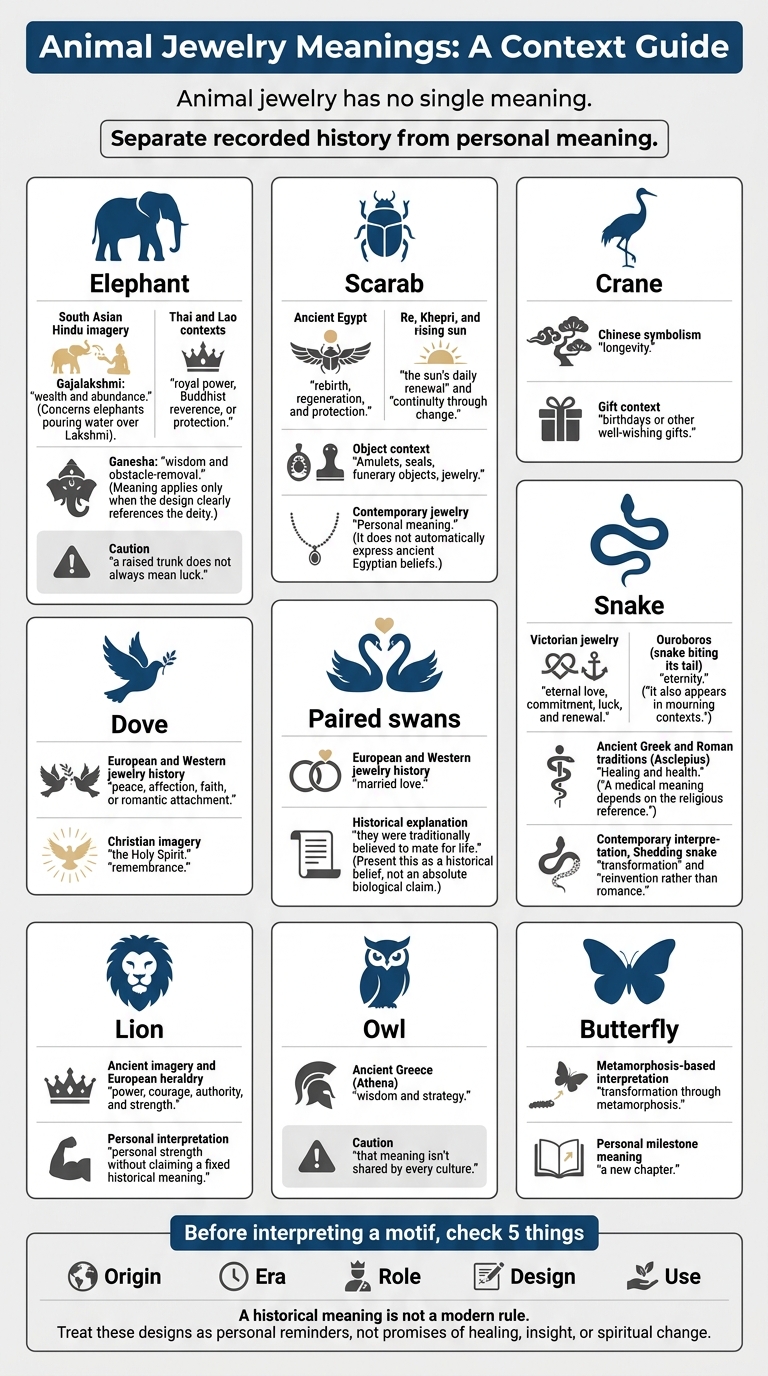
Animal Jewelry Meanings: A Context Guide
Animal Symbols of Luck, Love, and Strength
Luck: Elephants, Scarabs, and Cranes
In South Asian Hindu imagery, elephants pouring water over Lakshmi in her Gajalakshmi form are linked with wealth and abundance. In Thai and Lao contexts, elephant imagery may instead emphasize royal power, Buddhist reverence, or protection. An elephant pendant can suggest prosperity, but a raised trunk does not always mean luck.
Ancient Egyptian scarabs were associated with rebirth, regeneration, and protection. The Metropolitan Museum of Art connects them with Re and the sun’s daily renewal, while Johns Hopkins Archaeological Museum describes their protective role for the living and the dead. In Chinese symbolism, cranes are associated with longevity, making crane imagery especially fitting for birthdays or other well-wishing gifts.
Modern designs often mix these meanings. Other animal motifs have a more personal message, particularly in gifts and memorial jewelry.
Love: Doves, Swans, and Snakes
In European and Western jewelry history, doves can express peace, affection, faith, or romantic attachment, while paired swans suggest married love because they were traditionally believed to mate for life. The Victoria and Albert Museum also documents a turquoise dove motif associated with true love and protection in sentimental jewelry. Paired birds and a romantic inscription suggest a love token. Christian imagery may indicate the Holy Spirit, while a memorial setting can shift the meaning toward remembrance.
In Victorian jewelry, snakes could signify eternal love, commitment, luck, and renewal. Prince Albert’s serpent engagement ring for Queen Victoria helped popularize the motif. An ouroboros - a snake biting its tail - can suggest eternity, but it also appears in mourning contexts. Today, snake jewelry may signal transformation.
Giving snake jewelry as a romantic gift? Explain the meaning you intend so the recipient understands the message.
Strength and Protection: Lions and Animal Amulets
Jewelry-history sources connect lions in ancient imagery and European heraldry with power, courage, authority, and strength. A lion pendant can therefore suggest personal strength without claiming a fixed historical meaning. Egyptian scarabs, for example, were believed to support healing and protection.
Ask where a piece comes from and how it was used to learn whether its animal motif served as a protective symbol. The same animals can represent wisdom or renewal in other settings.
Animal Symbols of Wisdom and Change
Animal jewelry can represent more than luck and love. It can also point to wisdom or a major life change.
Wisdom: Owls and Elephants
In ancient Greece, the owl was linked to Athena, goddess of wisdom and strategy.
This history gives owl jewelry a classical meaning, but that meaning isn’t shared by every culture.
In Hindu tradition, Ganesha links the elephant with wisdom and obstacle-removal; that meaning applies only when the design clearly references the deity.
A snake can also signal healing in Greek tradition when it refers to Asclepius, not general wisdom.
Other animal designs speak more to transformation than wisdom.
Change and Renewal: Butterflies, Scarabs, and Snakes
Butterflies usually symbolize transformation through metamorphosis. Scarabs and snakes signal change only in specific cultural settings. A scarab can also mark continuity through change, rooted in Khepri and the rising sun. A shedding snake leans toward reinvention rather than romance.
When choosing milestone jewelry, match the message to its context. Meanings vary by region and era.
A butterfly can mark a new chapter; a scarab can suggest continuity through change; a shedding snake can signal a fresh start.
Treat these designs as personal reminders, not promises of healing, insight, or spiritual change.
How to Interpret and Choose Animal Jewelry
Meanings Across Regions and Eras
Read an animal motif through five checks: tradition, era, role, design, and use. First, check whether the source discusses jewelry, religious imagery, or broader symbolism. Use those details as evidence - not rules that apply to every piece.
Then compare the motif’s era, function, and setting.
Animal motif Documented culture or era Associated meaning Context to check Jewelry context Intertwined or ouroboros snake Victorian Britain, 19th century Love and eternity Mourning pieces may emphasize remembrance rather than romance Jewelry: sentimental rings, engagement pieces, mourning jewelry Snake associated with Asclepius Ancient Greek and Roman traditions Healing and health A medical meaning depends on the religious reference Religious imagery and archaeological jewelry: gems, rings, bracelets Scarab beetle Ancient Egypt Renewal and protection It may serve as a seal or funerary object, not just decoration Amulets, seals, funerary objects, jewelry Scarab beetle Contemporary jewelry Personal meaning It does not automatically express ancient Egyptian beliefs Fashion and commemorative jewelry
A historical meaning is not a modern rule. Before accepting a product’s symbolism claim, look for a named tradition, time period, and object type. A modern Egyptian-style piece should not be presented as expressing ancient symbolism without a named source.
With that context in place, focus on the wearer and the occasion.
Choosing a Motif with Personal Meaning
Start with who will wear the piece, where they’ll wear it, and what it marks - an anniversary, graduation, memorial, or personal transition. Look at what they already wear. Do they prefer subtle designs or statement pieces? Will the jewelry feel comfortable for daily use?
If a design includes sacred or community-specific imagery, consult reputable museum or community sources before calling it a general symbol.
Design affects how a motif reads. Posture can suggest calm or assertiveness, scale affects visibility, and metals or stones change the overall look. None of these choices establishes a universal meaning. Check dimensions, materials, and care instructions before buying.
LaCkore Couture’s customization options let you match the motif, metal, and scale to personal meaning. LaCkore Couture offers customizable necklaces, earrings, bracelets, rings, and charms in gold, silver, and natural stones. Review the designs, materials, and sizing before buying.
Conclusion: Balance Tradition and Personal Meaning
Animal motifs rarely have one fixed meaning. Their meanings can change across traditions and eras, so no single reading fits every piece of animal jewelry. Context matters: the tradition, the era, and how the piece is used.
Start with the documented tradition, then choose a personal meaning that fits the wearer. This is the safest approach to reading animal jewelry across world traditions. When giving a piece as a gift, consider the recipient’s beliefs and preferences. Add a short note explaining your choice without telling them what it must mean to them.
For everyday wear, check metal sensitivity, care needs, and details that could snag. A meaningful piece should suit the wearer’s daily life - not just convey a message.
FAQs
How can I verify an animal pendant’s symbolism?
Research what the animal has meant throughout history and within different communities. Meanings are guides, not fixed rules - they vary by region, era, and context. Motifs such as the Aztec jaguar or ancient Egyptian bee can reflect status, protection, or spiritual beliefs.
Before buying, check the design’s proportions and request a digital mockup. This lets you confirm that the details match your intended meaning before production begins.
Can one animal motif symbolize both love and change?
Yes. In jewelry, a bee’s dedication to its hive symbolizes loyalty and devotion, making bee-themed pieces a meaningful gift for romantic partners. Bees also support growth through pollination, so they can represent personal growth, life transitions, and positive change.
These meanings vary by region and era. Many animal motifs carry several layers of meaning, linking love with growth and transformation.
Is it respectful to wear animal symbols from another culture?
Wearing animal symbols from other cultures is a personal choice. For many people, it’s a way to honor the traits those symbols represent: strength in Aztec jaguar motifs, or patience and protection in Polynesian turtle symbols.
Before choosing a piece, consider what the design means and how it connects with your own journey. Paying attention to its meaning and craftsmanship can help you celebrate the symbol with respect and intention.