Skip to content




Ancient Egyptian Scarab Jewelry Meaning
The scarab beetle was a powerful symbol in ancient Egypt, representing rebirth, protection, and the eternal cycle of life. Scarab amulets were widely used from around 2575 BCE, serving both spiritual and practical purposes. They symbolized creation, renewal, and were closely tied to the god Khepri, who was believed to push the sun across the sky each day. Scarabs were also essential in burial rituals, protecting the deceased during the afterlife judgment.
Key points about scarab jewelry:
- Symbolism: Represented renewal, creation, and protection.
- Spiritual Role: Used in life as protective talismans and in death for safe passage into the afterlife.
- Materials: Crafted from steatite, faience, and semi-precious stones like lapis lazuli, carnelian, and jasper.
- Uses: Worn as rings, necklaces, and pectorals; also functioned as seals.
- Heart Scarabs: Placed on mummies during burial to aid in the "weighing of the heart" ceremony.
Today, scarab jewelry remains popular, symbolizing personal growth and transformation. Modern designs echo ancient craftsmanship, blending historical meaning with contemporary style.
Scarab Symbolism in Ancient Egypt
The scarab held a central place in Egyptian cosmology, symbolizing creation and renewal. This connection was inspired by the Egyptians' keen observation of the beetle's behavior, which they linked to profound spiritual concepts.
The God Khepri and the Sun
The dung beetle’s habit of rolling and shaping dung was seen as a reflection of divine acts. Ancient Egyptians believed this process mirrored the actions of Khepri, the god of the morning sun, who was thought to roll the sun disk across the sky each dawn. The word for scarab in Egyptian, Kheper, translates to "to come into existence" or "to develop", emphasizing themes of creation. In their understanding of the solar cycle, Khepri represented the rising sun and the promise of renewal, while Ra governed the midday sun and Atum the evening sun, creating a seamless cycle of progression throughout the day. As Maria M. van Ryneveld, a researcher, noted:
"The central belief surrounding Khepri was the god's ability to renew life, in the same way he restored the sun's existence every morning."
The funerary text Amduat vividly portrays this cycle, showing Khepri guiding the solar barque during the final hour of night. His role was to push the sun out of the underworld, marking the dawn of a new day. This divine imagery established the scarab as a powerful symbol of rebirth and renewal.
Rebirth and Eternal Life
The scarab's life cycle further reinforced its association with rebirth. Egyptians observed young beetles seemingly emerging spontaneously from dung balls, which led them to view the scarab as a self-creating entity and a potent symbol of regeneration. As Kholoud Mohamed Shawky, Ph.D. candidate and classicist, explained:
"The scarab is 'a living symbol of eternal rebirth.'"
The beetle’s use of dung balls, both as sustenance and as a protective space for its eggs, highlighted an ongoing cycle of transformation. This symbolism was deeply woven into Egyptian funerary practices. Heart scarabs, typically ranging in size from 1.6 to 4.7 inches (approximately 4–12 cm), were placed over the hearts of mummies. These amulets were far more than decorative; they played a crucial role in the "weighing of the heart" ceremony. Inscribed with Spell 30B from the Book of the Dead, the scarab would command, "Do not stand up against me as a witness", shielding the deceased and ensuring their safe journey into eternal life.
How Scarab Jewelry Was Made
Ancient Egyptian artisans used intricate techniques like carving, molding, and glazing to create scarab jewelry. They worked with a variety of materials, ranging from soft stones to precious metals, crafting pieces that carried both practical uses and deep cultural significance.
Forms of Scarab Jewelry
Scarab jewelry came in many forms, each with its own purpose and style. Rings, for instance, evolved from simple scarab designs tied with thread to more refined swivel rings, where the scarab was drilled and strung on gold wire for durability and elegance. Necklaces and bracelets often featured scarab beads as central amulets, believed to offer protection. Larger pieces, like pectorals worn on the chest, sometimes measured between 1.2 and 3.1 inches (3 to 8 cm) and were adorned with winged scarabs. These were even sewn onto mummy wrappings to provide protection in the afterlife.
The size of scarabs varied depending on their purpose. Common scarabs were typically between 0.4 and 0.8 inches (10 to 20 mm), but some ranged from as small as 0.2 inches (6 mm) to as large as 1.6 inches (40 mm).
Materials Used in Scarab Jewelry
The choice of materials was just as important as the craftsmanship. Steatite, also known as soapstone, was the most frequently used material. Its softness made it easy to carve, but once fired in a kiln, it hardened into durable enstatite. Egyptian faience, a ceramic made from sintered quartz, was another popular choice. It was often glazed in blue or green to replicate the beetle’s shimmering shell while symbolizing rebirth.
For more luxurious pieces, artisans turned to semi-precious stones like amethyst, carnelian, lapis lazuli, turquoise, and green jasper. Each stone had its own symbolic meaning. For instance, green jasper was specifically mentioned in Chapter 30 of the Book of the Dead as the material for the heart scarab, as noted by Egyptologist Morgan Moroney:
"Chapter 30 [of the Book of the Dead] prescribed what is believed to be green jasper for the heart scarab".
Precious metals like gold and silver were also used, often as settings or frames. These materials signified divinity and high social status.
To shape these materials, artisans relied on specialized tools. Softer stones were worked with metal tools, while harder materials like carnelian and amethyst required tubular and bow drills. After carving or molding, the scarabs were coated with colored glazes and fired to achieve a glossy, glass-like finish. The flat base of the scarab was then engraved with intricate designs, such as hieroglyphs, royal names, or protective spells, using fine tools made from flint or obsidian.
The combination of skilled techniques, meaningful materials, and detailed engraving ensured that scarabs remained powerful symbols of rebirth and protection throughout Egyptian history.
Scarab Jewelry for the Living and the Dead
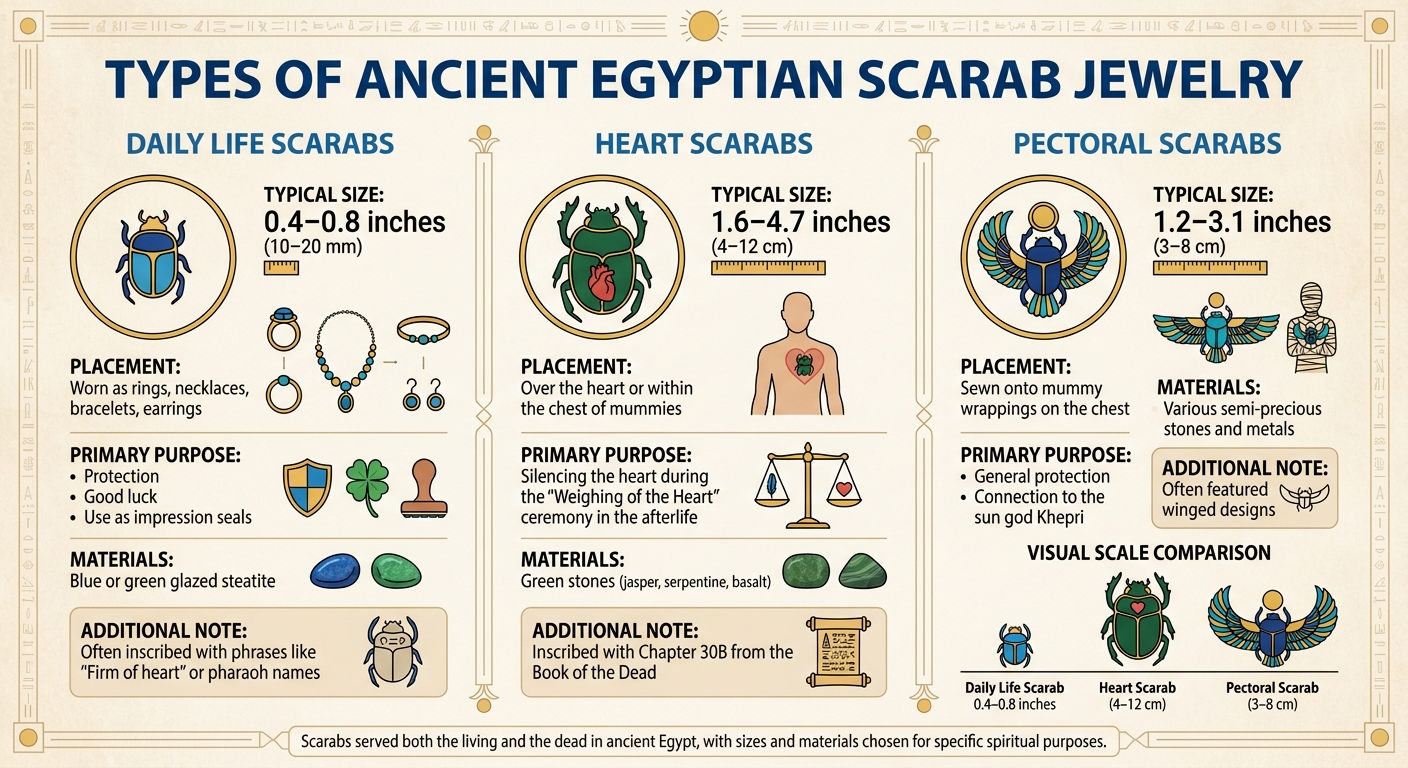
Types of Ancient Egyptian Scarab Jewelry: Sizes, Placement, and Purposes
In ancient Egypt, scarab jewelry was more than ornamental - it was believed to protect the living and guide the dead. These amulets were cherished by both the wealthy and the common folk, as they were thought to carry divine powers that shielded against harm and secured favor from the gods.
Protective Charms for Daily Life
Scarab amulets were everyday talismans fashioned into rings, necklaces, bracelets, and earrings. Their connection to the god Khepri symbolized protection and good fortune. As Elaine A. Evans, Curator at McClung Museum, noted:
"The small magical object was believed imbued with particular protective powers that warded off evil and provided good things for the owner for this life and also for the next."
The flat bases of these scarabs were often inscribed with images of deities or pharaohs to enhance their protective qualities. While the elite favored detailed inscriptions, simpler phrases like "Firm of heart" or "Amun is strength" were common among ordinary people. The throne name of Thutmose III (Men Kheper Re) was a particularly popular inscription, serving as a protective charm for centuries.
Beyond their spiritual significance, scarabs had practical uses too. They doubled as impression seals to secure jars, bags, boxes, and even doors. These everyday scarabs were typically small, ranging from 0.4 to 0.8 inches (10–20 mm), and were often made from blue or green glazed steatite.
While these amulets offered daily protection, scarabs took on an even deeper meaning in burial practices.
Heart Scarabs and Burial Rituals
Scarab amulets provided protection in life, but heart scarabs were essential for ensuring a safe journey into the afterlife. These larger amulets, measuring between 1.6 and 4.7 inches (4–12 cm), were placed over the chest of the deceased during the "Weighing of the Heart" ceremony. Ancient Egyptians believed the heart was the seat of intellect and memory, and during judgment, it was weighed against the feather of Ma'at to determine the soul's worthiness.
The heart scarab's role was to silence the heart during this judgment, preventing it from testifying to the deceased's sins. Many of these scarabs were inscribed with Chapter 30B of the Book of the Dead, which included a plea:
"O my heart which I received from my mother... do not stand up against me as a witness! Do not create opposition against me among the assessors! Do not tip the scales against me in the presence of the Keeper of the Balance!"
- Thomas J. Logan, Translator
Heart scarabs were typically carved from green stones like jasper, serpentine, or basalt, symbolizing renewal and resurrection. One remarkable example is the Heart Scarab of Hatnefer, a noblewoman from Thebes (c. 1473 B.C.). Her serpentinite scarab, measuring 2.6 inches (6.6 cm), was encased in gold and hung from a 30.5-inch (77.5 cm) gold chain. This artifact, discovered in the 1930s and now housed at the Metropolitan Museum of Art, features an inscription of Chapter 30B along with Hatnefer's name, suggesting it was repurposed for her burial.
| Scarab Type | Typical Size | Placement | Primary Purpose |
|---|---|---|---|
| Daily Life Scarabs | 0.4–0.8 inches | Worn as rings, necklaces, bracelets | Protection, good luck, and use as impression seals |
| Heart Scarabs | 1.6–4.7 inches | Over the heart or within the chest | Silencing the heart during the afterlife judgment |
| Pectoral Scarabs | 1.2–3.1 inches | Sewn onto mummy wrappings | General protection and connection to the sun god Khepri |
This table highlights the varied purposes of scarabs, emphasizing their role as symbols of protection and guidance both in life and beyond.
The enduring significance of scarab jewelry lies in its dual purpose: safeguarding the living and ensuring the dead a smooth passage to the afterlife.
Scarab Jewelry Today
The scarab symbol, rooted in ancient Egyptian culture, continues to thrive in modern jewelry, symbolizing transformation and protection. Today’s designers have reimagined this ancient emblem, weaving its timeless significance into contemporary pieces. This blend of history and modernity reflects the lasting influence of Egyptian beliefs, seamlessly connecting past traditions with present-day aesthetics.
Scarab Symbols in Modern Jewelry
Modern scarab jewelry carries a deep resonance, especially for those navigating personal growth or change. The scarab’s rich symbolism - rebirth, regeneration, and protection - remains as relevant today as it was thousands of years ago. As Temple of the Sun puts it:
"Scarabs resonate most with those undergoing their own personal evolution, acting as a protective talisman to provide safe passage even in the most uncomfortable moments of transformation."
Designers incorporate scarabs into necklaces, bracelets, rings, and earrings using luxurious materials like 18k gold vermeil, amethyst, jasper, and lapis lazuli. These choices echo the semi-precious stones cherished by ancient Egyptian artisans. For instance, in early 2026, Temple of the Sun unveiled a Scarab Necklace crafted from 18k Ethical Gold Vermeil, designed as a protective symbol for those experiencing personal transformation. Meanwhile, artisans in Luxor, Egypt carry on the ancient tradition, hand-carving scarab beads from soapstone, maintaining a direct link to this millennia-old craft.
The scarab’s cultural significance also extends beyond jewelry. It appears in popular culture, such as on album covers for the rock band Journey, and as a key element in films like The Mummy and Disney's Aladdin.
LaCkore Couture and Scarab-Inspired Designs

LaCkore Couture is among the designers embracing this enduring symbol, infusing their handcrafted collections with the scarab’s rich heritage. Their pieces, made in the USA, highlight natural stones, gold, and silver, reflecting the artisanal traditions of ancient Egyptian jewelry.
What sets LaCkore Couture apart is their focus on personalization. Wearers can create their own talismans by combining charms or stacking bracelets, echoing the ancient practice of inscribing scarabs with protective spells. These modern designs serve as more than just accessories - they are meaningful adornments that continue the scarab’s legacy of protection and rebirth. Each piece bridges the gap between contemporary fashion and the timeless power of this ancient symbol.
Conclusion
The scarab beetle's journey from ancient Egyptian culture to modern jewelry highlights the lasting power of symbols that speak to universal truths. For over thousands of years, this unassuming beetle symbolized the god Khepri and the divine essence of the morning sun, representing transformation and renewal. To the ancient Egyptians, its daily activity of rolling a ball of dung mirrored the cycle of life itself - a constant process of rebirth. Today, this symbolism finds a new home in contemporary jewelry, where each design continues to echo these timeless ideas.
Scarab artifacts, still widely discovered, offer a window into the artistry of ancient Egypt. They ranged in size and purpose, from tiny seals used in administration to larger commemorative pieces. The materials chosen by ancient craftsmen - lapis lazuli symbolizing the heavens, carnelian representing vitality, and gold embodying eternity - weren’t just visually striking but also carried deep spiritual meaning. Modern designers draw inspiration from these choices, appreciating their blend of beauty and significance.
Heart scarabs, which once protected the deceased during judgment, now resonate with modern wearers seeking protection and resilience in their personal journeys. This once-religious icon has evolved into a versatile symbol that appears in popular culture, from album covers by Journey to blockbuster films like The Mummy and Aladdin. Its relevance has endured across generations, adapting to new contexts while retaining its core meaning.
Rooted in ancient rituals and divine connections, the scarab continues to bridge centuries of spiritual and artistic expression. Modern artisans, including brands like LaCkore Couture, honor this legacy by blending ancient symbolism with contemporary style. Whether crafted from 18k gold vermeil or intricately carved soapstone, each piece reflects the enduring belief that symbols hold profound meaning when worn with intention. The scarab's message - that transformation is sacred and life is a cycle of renewal - remains as compelling today as it was along the Nile thousands of years ago.
FAQs
Why were scarabs linked to the sun god Khepri?
The scarab beetle held deep significance in ancient Egyptian culture, closely tied to the sun god Khepri. This connection stemmed from the beetle’s symbolic association with the renewal and rebirth of the morning sun. Khepri, representing the sun’s daily journey, was frequently depicted as a scarab, emphasizing the insect’s link to transformation and divine power.
What was the purpose of a heart scarab in the afterlife judgment?
The heart scarab played a crucial role in the weighing of the heart ceremony in the underworld. Its purpose was to silence the heart, preventing it from speaking falsely or acting against the deceased. This ensured the individual could pass judgment and secure a positive outcome in the afterlife.
How can you tell an ancient scarab from a modern one?
Ancient scarabs can be recognized by their historical inscriptions, craftsmanship, and visible signs of age, like wear or patina. Genuine scarabs often display distinct symbols and intricate details that reflect their specific era. In contrast, modern reproductions usually appear newer, more uniform, and miss the authentic historical elements that define the originals.